


This article is for informational purposes only. It is not, nor is it intended to be, a substitute for professional medical advice, diagnosis, or treatment and should never be relied upon for specific medical advice.
Best default for a previously diagnosed, uncomplicated yeast infection: a vaginal azole such as clotrimazole. Best shorter-course option: miconazole; best prescription option without vaginal insertion: fluconazole. This 2026 guide compares the best overnight treatments for yeast infections—and explains why bedtime treatment does not mean an overnight cure.
TL;DR
- The best overnight treatments for yeast infections treat confirmed yeast; topical azoles are the usual starting point.
- Clotrimazole suits women who prefer a longer vaginal treatment course; miconazole offers shorter-course formulations.
- Fluconazole requires a prescription and medication review; oral fluconazole is not recommended during pregnancy.
- Kushae boric acid suppositories require a different decision: clinician-directed care for selected recurrent infections, not routine first-line treatment.
Why this matters
Itching, burning, and discharge do not identify the cause on their own. The CDC’s Vulvovaginal Candidiasis guidance states that these symptoms are not specific to yeast. BV, other infections, and irritated skin need different care.
The Kushae OB/GYN-developed care line includes external products and vaginal suppositories. These categories are not interchangeable: a vulvar wash cleans external skin, while an intravaginal antifungal treats vaginal yeast.
Choose treatment by diagnosis and active ingredient—not by how quickly a package promises freshness. Persistent odor, repeated symptoms, or a first episode deserves medical evaluation rather than another product added to your routine.
What makes the best overnight yeast treatment?
For this 2026 comparison, the deciding criteria are medical fit and safe use—not a promise that symptoms disappear by morning.
- Evidence for yeast treatment: An antifungal regimen should have support in clinical guidance. General ingredient evidence does not establish results for every branded formula.
- The right diagnosis: A familiar, previously diagnosed uncomplicated infection differs from recurrent symptoms or an uncertain first episode.
- A suitable treatment course: Follow the full labeled or prescribed course, even when itching improves before it ends.
- Pregnancy safety: Pregnancy changes the recommendation. The CDC recommends topical azoles for 7 days during pregnancy.
- Clear route of use: Vaginal medicines, oral medicines, and external skin products have different instructions and limits.
- Tolerability and precautions: Local burning, medication interactions, and contraceptive compatibility belong in the decision.
Overnight yeast treatments at a glance
The ranking below separates treatment routes and use cases. It is not a claim that one medicine works better for every woman.
| Option | Best for | Standout feature | Key limitation |
|---|---|---|---|
| Clotrimazole vaginal cream | A longer-course topical default for uncomplicated yeast | Established vaginal azole treatment | Requires repeated application; local irritation is possible |
| Miconazole vaginal suppositories | A shorter vaginal course when appropriate | Established 3-day formulations | Shorter dosing does not guarantee faster symptom relief |
| Prescription oral fluconazole | Avoiding vaginal insertion when medically appropriate | Oral treatment option | Requires interaction and pregnancy screening |
| Boric acid vaginal suppositories, including Kushae boric acid suppositories | A clinician-directed plan for selected recurrent non-albicans infections | A different option in specific clinical circumstances | Not routine first-line care; harmful if swallowed |
Understand the treatment routes
Vaginal antifungals deliver medicine inside the vagina. Prescription tablets treat through an oral route. Boric acid belongs in selected clinician-directed treatment plans, not in an automatic rotation whenever itching returns.
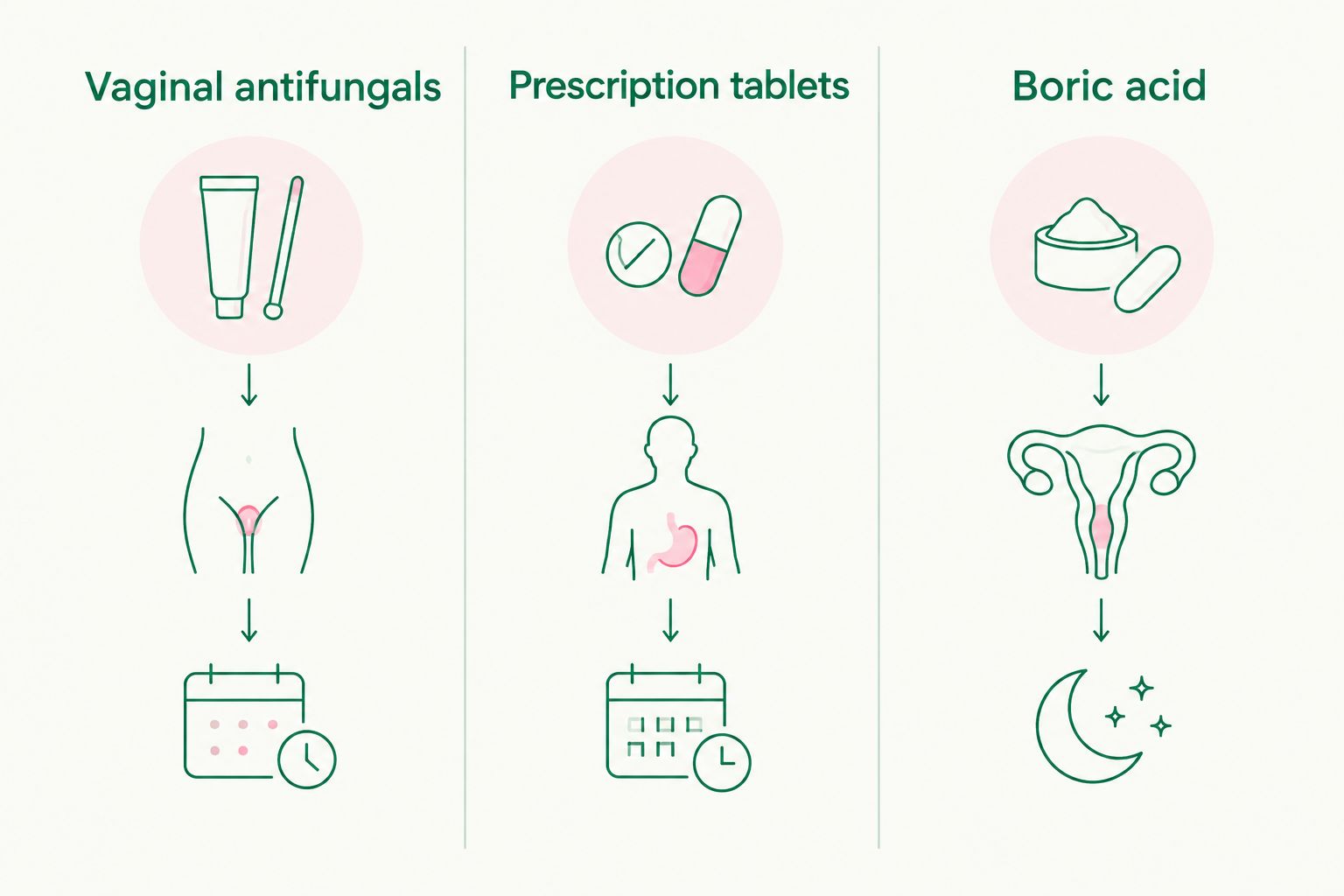
External washes, deodorants, and skin balms sit outside this treatment comparison. They do not replace antifungal medicine, and an external cleanser does not treat BV.
1. Clotrimazole: best for a longer-course topical default
Clotrimazole is an azole antifungal available in vaginal formulations. The CDC lists clotrimazole 1% cream, 5 g intravaginally daily for 7–14 days, among recommended regimens for uncomplicated vulvovaginal candidiasis. Follow the directions for the exact formulation you select.
Bedtime application fits many routines, but the treatment course continues beyond the first night. A longer course also requires you to keep applying medicine after symptoms begin to settle.
Clotrimazole pros:
- Treats vaginal yeast rather than masking odor or itching.
- Has a place in established clinical treatment guidance.
- Provides a topical alternative to an oral prescription.
Clotrimazole cons:
- Requires repeated vaginal application.
- Can cause local burning or irritation.
- Some vaginal cream formulations affect latex barrier contraception; check the product instructions.
Best for: Someone with a previously diagnosed, familiar uncomplicated yeast infection who prefers a longer topical course and has no reason to seek evaluation first.
Verdict: Buy only when self-treatment is appropriate, and complete the full labeled course. If you are pregnant, ask your prenatal clinician which 7-day topical azole to use rather than choosing by this ranking alone.
2. Miconazole: best for a shorter vaginal course
Miconazole is another vaginal azole antifungal. The CDC includes a regimen of one 200 mg vaginal suppository daily for 3 days for uncomplicated infection. Other formulations have different directions, so the product name alone is not enough to determine the schedule.
A shorter course means fewer scheduled applications. It does not establish that itching, inflammation, or discharge will disappear sooner than with a longer course.
Miconazole pros:
- Has established clinical support for uncomplicated vaginal yeast.
- Offers a defined shorter-course suppository option.
- Avoids taking an oral tablet.
Miconazole cons:
- Can cause vaginal burning or irritation.
- Does not treat BV or other causes of similar symptoms.
- Requires medication checks; MedlinePlus advises discussing medicines including warfarin before vaginal miconazole use.
Best for: Someone eligible for self-treatment who prefers fewer vaginal applications and can follow the exact formulation’s instructions.
Verdict: Buy for an appropriate uncomplicated infection—not because a shorter course promises an overnight cure. In this 2026 guide, convenience earns a distinct use-case slot, not a claim of faster healing.
3. Fluconazole: best for avoiding vaginal insertion
Fluconazole is a prescription oral antifungal. The CDC lists a single oral dose as an option for uncomplicated vulvovaginal candidiasis, but a clinician must determine whether it fits your diagnosis, medicines, and health history.
An oral route avoids applying cream or inserting a suppository. It also introduces systemic precautions that a convenient dose does not remove.
Fluconazole pros:
- Offers treatment without vaginal insertion.
- Has established clinical support for uncomplicated yeast infection.
- Provides a prescription option when a clinician selects an oral route.
Fluconazole cons:
- Can interact with other medicines.
- Can cause adverse effects, including nausea and abdominal discomfort.
- Is not recommended for vaginal yeast treatment during pregnancy.
Best for: A nonpregnant patient whose clinician confirms that an oral antifungal is suitable and checks for interactions.
Verdict: Hold until prescribed for your situation. Do not take a leftover tablet or someone else’s prescription because the symptoms seem familiar. Recurrent or severe infections can require a different plan from uncomplicated yeast.
4. Boric acid: best for selected clinician-directed recurrences
Boric acid is not the default alternative when a standard yeast treatment disappoints. The CDC places vaginal boric acid in a specific pathway for recurrent non-albicans vulvovaginal candidiasis after an initial treatment approach—not as the usual treatment for a first suspected infection.
Kushae boric acid suppositories are best considered by women whose clinician recommends boric acid for confirmed recurrent non-albicans yeast. The listed formula includes probiotics and aloe, but those additions do not establish better yeast-treatment outcomes or prove that it restores a vaginal microbiome.
Boric acid pros:
- Has a role in guidance for selected recurrent non-albicans infections.
- Offers a different approach when a clinician determines it is appropriate.
- Supports a diagnosis-specific discussion rather than repeated guessing.
Boric acid cons:
- Is harmful if swallowed and must be kept away from children and pets.
- Is not appropriate for self-directed use during pregnancy.
- Can irritate vaginal tissue and does not replace evaluation of persistent symptoms.
Clinical evidence for vaginal boric acid does not demonstrate the effectiveness of a particular Kushae formula. The product’s strength and directions must match the plan your clinician recommends; do not assume every capsule or brand is equivalent.
Best for: Someone with a confirmed recurrent non-albicans infection and an explicit clinician-directed treatment plan.
Verdict: Hold unless your clinician recommends it. Never swallow a vaginal suppository or use boric acid as a nightly freshness product.
How the options rank
This 2026 ranking follows the roles described in the CDC’s Vulvovaginal Candidiasis treatment guidance. Clotrimazole earns the longer-course topical slot; miconazole earns the shorter-course vaginal slot; fluconazole earns the prescription oral slot. Boric acid remains a conditional option for a narrower diagnosis.
These are use-case recommendations, not results from a head-to-head product trial. ACOG’s Vaginitis patient guidance supports evaluating vaginal symptoms rather than assuming every episode is yeast. MedlinePlus drug information supplies additional medication precautions.
Which overnight yeast treatment should you choose?
For a familiar, previously diagnosed uncomplicated infection, a labeled vaginal azole is the default—not a wash, deodorant, or routine boric acid capsule. Choose the formulation and course you can follow correctly. Ask a pharmacist about interactions and the package’s contraception precautions.
If this is your first episode, the symptoms differ from previous infections, or treatment has failed, choose an appointment before another product. Testing can distinguish yeast from BV and other causes; a shopping comparison cannot.
For your 2026 care decisions, keep these boundaries clear:
- Persistent symptoms: The CDC recommends clinical evaluation when symptoms persist after an over-the-counter treatment.
- Symptoms returning soon: Recurrence within 2 months after treatment also warrants evaluation under CDC guidance.
- Frequent infections: Three or more symptomatic episodes within 1 year meet the CDC definition of recurrent vulvovaginal candidiasis.
- Pregnancy or complicated health history: Pregnancy, poorly controlled diabetes, or immune suppression changes treatment decisions.
- Concerning symptoms: Fever, pelvic pain, sores, or unusual bleeding need medical assessment rather than another round of self-treatment.
Bring the product package and a list of recent treatments to your appointment. Include vaginal products, antibiotics, and any previous test results so the clinician can assess what happened—not just what you tried last night.
FAQ
What's the best overnight treatment for a yeast infection?
A vaginal azole such as clotrimazole or miconazole is a standard option for an uncomplicated yeast infection when self-treatment is appropriate. Bedtime use does not mean the infection will clear overnight; finish the labeled course.
Can a yeast infection go away after one night of treatment?
One night of treatment does not guarantee that a yeast infection has cleared. A short dosing schedule describes how to take the medicine, not a guaranteed deadline for symptom relief.
Are boric acid suppositories better than miconazole?
Boric acid suppositories are not the routine first choice over miconazole for uncomplicated vaginal yeast. CDC guidance reserves a role for boric acid in selected recurrent non-albicans infections, which require diagnosis-specific care.
Can I use Kushae feminine wash to treat a yeast infection?
Kushae feminine wash is an external-care product, not a treatment for vaginal yeast or BV. Do not put an external cleanser inside the vagina or use it instead of prescribed or labeled antifungal medicine.
What yeast treatment can I use while pregnant?
The CDC recommends topical azole treatment for 7 days during pregnancy. Ask your prenatal clinician which product to use; oral fluconazole is not recommended, and boric acid is not an alternative for self-treatment.
Should I treat vaginal odor as a yeast infection?
Vaginal odor alone is not a diagnosis of yeast infection. New, persistent, or strong odor—especially with discharge or irritation—needs evaluation for BV and other causes rather than repeated antifungal treatment.
When should I see a clinician instead of buying another treatment?
Seek evaluation if symptoms persist after over-the-counter treatment or return within 2 months. First episodes, pregnancy, frequent recurrences, fever, pelvic pain, sores, or unusual bleeding also require medical assessment.
One last thing
A 1-day treatment is a dosing schedule, not a promise of a 1-day cure. That distinction matters when you are uncomfortable and tempted to layer products. Finish the directed treatment, avoid adding products to cover symptoms, and arrange evaluation if symptoms persist.


