


This article is for informational purposes only. It is not, nor is it intended to be, a substitute for professional medical advice, diagnosis, or treatment and should never be relied upon for specific medical advice.
You can use feminine wash every day on the external vulva if the product is suitable for that area and your skin tolerates it, but daily cleanser is not necessary for everyone. Never wash inside the vagina, and do not use an external wash to treat BV, yeast infections, or persistent vaginal odor.
TL;DR
- Can you use feminine wash every day? Yes, externally if tolerated; stop if it causes irritation.
- ACOG distinguishes vulvar care from vaginal cleansing: the vagina does not need internal washing.
- A pH-balanced feminine wash does not diagnose, treat, or prevent BV.
- For sensitive external intimate skin, choose a simple routine rather than adding more products.
Can you use feminine wash every day?
Daily external washing is reasonable. Whether you need a cleanser depends on your skin, the product, and any symptoms you already have. Daily hygiene does not require daily feminine wash.
The American College of Obstetricians and Gynecologists, in Vulvovaginal Health, explains that the vagina cleans itself and distinguishes it from the external vulva. That distinction is the foundation of this 2026 guide: clean the outside gently, and leave the vaginal canal alone.
| Option | Best for | Benefit | Limit or drawback |
|---|---|---|---|
| Lukewarm water | A minimal external routine, especially when cleansers sting | Cleans without adding cleanser ingredients | Does not diagnose or treat an infection |
| Mild, fragrance-free cleanser | External skin that tolerates cleanser | Helps remove surface sweat and residue | Can still irritate sensitive skin |
| Feminine wash labeled for external use | Readers who prefer a dedicated external cleanser | Provides an external cleansing option | The category name does not guarantee tolerance or infection prevention |
For help evaluating labels, see the guide to feminine wash for sensitive skin. A wash should earn its place by being comfortable to use—not by promising that normal genital skin needs correcting.
Why this matters
Recurring vaginal odor can make you feel that you need to wash more. That response is understandable, but extra cleansing does not address every cause of odor and can add irritation to an existing problem.
External sweat and vaginal discharge are not the same thing. Sweat collects on surrounding skin; discharge comes from the vagina. The source of a symptom changes what care makes sense.
For your 2026 routine, separate two decisions: how to clean external skin and whether vaginal symptoms need evaluation. A product purchase should not replace the second decision.
External vulvar care is not internal vaginal cleansing
The vulva includes the external genital structures, including the labia. The vagina is the internal canal. Product names often blur those terms, so read the directions rather than relying on the word feminine.
An external cleanser belongs only where its label directs you to use it. Do not insert it into the vagina, use it as a douche, or try to rinse the vaginal canal with a shower stream.
ACOG's Vulvovaginal Health guidance supports avoiding douching. The CDC's Bacterial Vaginosis clinical guidance also identifies douching as a practice that can increase the risk of BV relapse.
A clean vulva does not require a washed-out vagina. Internal cleansing is not an extra step in a thorough routine; it is a different practice with different risks.
How do you use feminine wash without overdoing it?
Keep the process gentle. The goal is to remove surface residue without leaving your skin burning, tight, or uncomfortable.
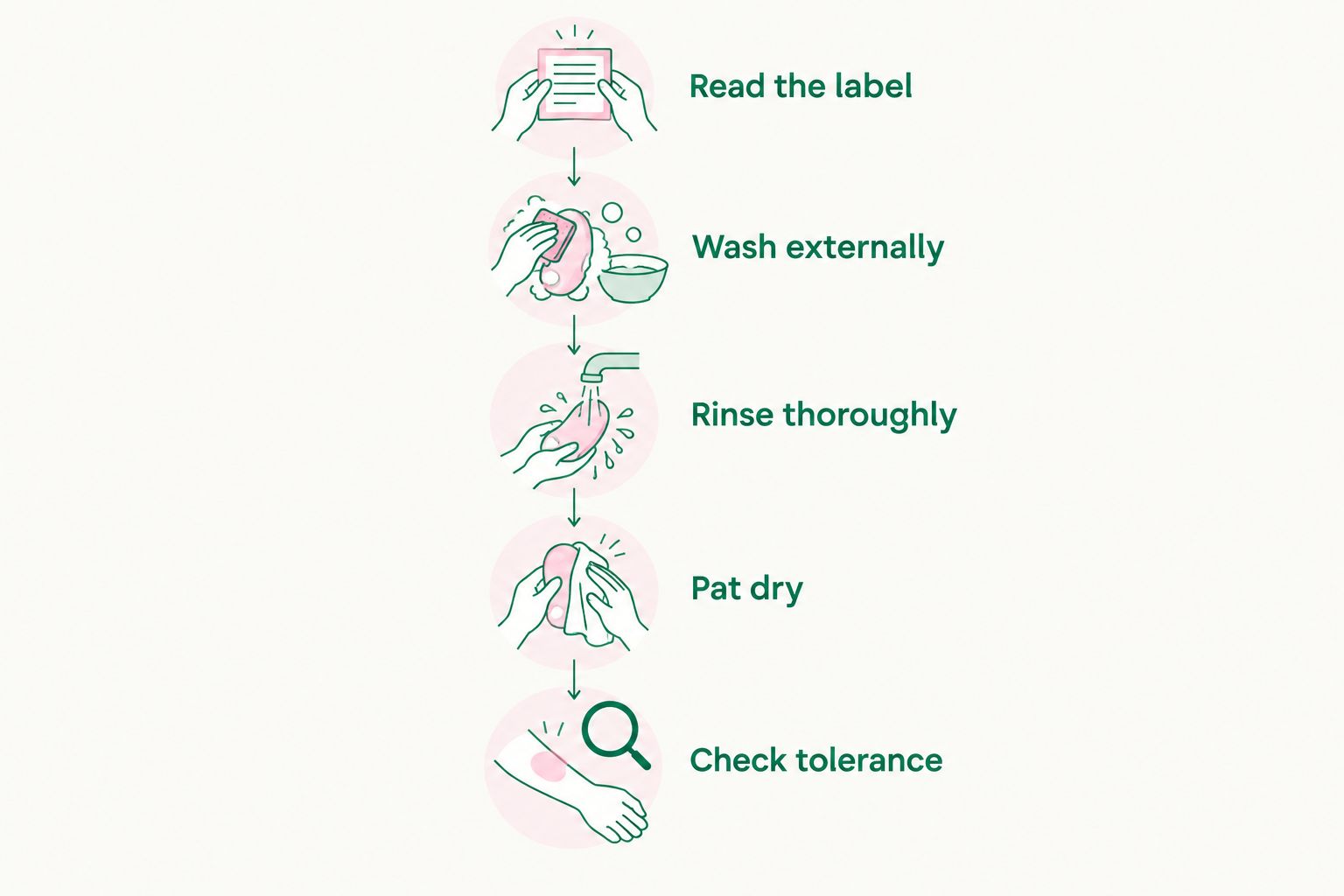
- Read the label. Confirm that the product is intended for external intimate skin. Follow its directions rather than assuming every wash works the same way.
- Wash externally. Use clean hands and lukewarm water. Avoid scrubbing brushes, rough washcloths, and direct washing inside the vagina.
- Rinse thoroughly. Remove cleanser from the areas where you applied it. Do not leave a rinse-off product on the skin as a treatment.
- Pat dry. Use a clean, soft towel without rubbing. Pay attention to whether your skin feels comfortable afterward.
- Check tolerance. Stop the product if burning, itching, redness, or tightness starts or worsens. Persistent symptoms need assessment rather than another cleanser.
This 2026 checklist is about technique, not a requirement to use more products. If water alone keeps your external skin comfortable, adding a feminine wash is optional.
Why daily feminine wash tolerance varies
The same routine does not suit every vulva. Your response to a product matters more than the category printed on the bottle.
- Ingredients. Fragrance and other ingredients can irritate sensitive vulvar skin. A familiar ingredient list does not rule out a reaction.
- Existing irritation. Skin that already burns or itches needs a simpler approach and, when symptoms persist, medical evaluation.
- Washing technique. Scrubbing, rubbing, and hot water add irritation that a gentle-sounding product name cannot cancel out.
- Repeated exposure. Adding a wash after every bathroom visit, workout, or odor concern creates more opportunities for irritation.
- Other products. Wipes, sprays, pads, lubricants, and detergents can complicate the picture. Consider the full routine, not just the cleanser.
- Life stage and health. Menopause, pregnancy, and vulvar skin conditions can change your care needs. Ask your clinician for advice specific to your situation.
Do not push through stinging because a product says it is gentle. Discomfort is a reason to stop, not evidence that the wash is working.
Does pH-balanced feminine wash prevent BV?
No. A pH-balanced feminine wash is not an established treatment or prevention method for BV. Its intended use on external skin does not establish what it does inside the vagina.
Vaginal pH and a cleanser's pH describe different things. In the CDC's BV diagnostic criteria, a vaginal fluid pH above 4.5 is one finding clinicians consider alongside other evidence; it does not diagnose BV by itself.
That number is not a target for choosing a body cleanser. It also does not mean you should try to adjust vaginal pH by washing more often or inserting an external product.
For this 2026 buying decision, treat pH-balanced as a label claim to examine—not proof that a wash prevents infection. Ask where the product is used, what its directions say, and whether your skin tolerates it.
What if you are washing because vaginal odor keeps returning?
Recurring vaginal odor calls for assessment, not escalating cleansing. A stronger wash or another scented product does not establish why the odor is happening.
The CDC's About Bacterial Vaginosis describes symptoms that can include a strong fish-like odor and thin white or gray discharge. Other conditions can cause overlapping symptoms, so an article cannot confirm the cause from smell alone.
Arrange medical care for persistent or recurring odor, changed discharge, itching, burning, or pain with urination. Seek prompt care if you also have pelvic pain, fever, or feel unwell; pregnancy with new vaginal symptoms also deserves medical attention.
When you book an appointment, explain what changed and what you have already used. Include washes, wipes, sprays, suppositories, and recent treatments. That history helps your clinician assess both infection and possible product irritation.
Where Kushae fits in an external care routine
Kushae's OB/GYN-developed vulvovaginal care line is an option for women seeking dedicated intimate-care products, not a substitute for diagnosing recurring odor. For daily washing, focus specifically on the external wash rather than treating every product in the line as interchangeable.
| Product | Best for | Practical benefit | Limit |
|---|---|---|---|
| Kushae Gentle 2-N-1 Foaming Feminine Wash | Readers who prefer a dedicated foaming wash for external care | A foaming cleanser option within the brand's care line | Not a BV or yeast treatment; individual tolerance still matters |
| Gentle 2-N-1 Foaming Wash - Travel Size | Readers choosing a smaller wash format for travel | The listed travel bottle contains 1.33 oz | A smaller bottle does not establish different medical benefits or better tolerance |
Kushae's OB/GYN-developed positioning describes the brand's care approach. It does not establish that a particular formula prevents BV, treats yeast, or suits every person with sensitive skin.
Before choosing either wash, check the current ingredient list and directions. If your clinician has advised avoiding cleansers because of dermatitis or another vulvar condition, follow that advice rather than treating a product label as an exception.
External wash options
Can you use feminine wash more than once a day?
More washing is not automatically better. If external skin needs refreshing after exercise, a gentle water rinse and a change out of damp clothing are simpler than repeatedly applying cleanser.
Do not make extra washes your response to persistent vaginal odor. If you keep feeling that you need another wash, reassess the symptom rather than increasing the product.
Should you stop feminine wash if it burns?
Yes. Stop using a feminine wash that causes burning, rinse the external area gently, and avoid adding other products to counteract the reaction.
Burning can reflect irritation or another condition. If it persists, worsens, or comes with discharge, sores, or urinary symptoms, get medical advice.
Can you use feminine wash during your period?
You can gently wash the external vulva during your period. Menstrual bleeding does not create a need to clean inside the vagina or use a stronger cleanser.
Keep the same tolerance-based approach. If pads, moisture, or a cleanser seem to aggravate your skin, simplify the routine and discuss persistent irritation with your clinician.
Medical sources and scope
The medical education in this 2026 guide draws on ACOG's Vulvovaginal Health, the CDC's Bacterial Vaginosis clinical guidance, and the CDC's About Bacterial Vaginosis. These sources address anatomy, douching, BV symptoms, and diagnosis—not clinical testing of the wash products shown here.
General medical guidance does not prove results for a specific formula. This article provides education, not a diagnosis or an individualized treatment plan.
FAQ
Can you use feminine wash every day if you have sensitive skin?
You can use feminine wash externally every day only if your skin tolerates it, but sensitive skin does not require a daily cleanser. Stop if it causes burning, itching, redness, or tightness, and seek advice for persistent symptoms.
Do I need feminine wash to keep my vagina clean?
No, you do not need feminine wash to clean inside your vagina. The vagina cleans itself; external vulvar care is separate and should stay gentle.
Can daily feminine wash prevent BV from coming back?
Daily feminine wash is not an established way to prevent recurrent BV. Repeated symptoms need a clinician-directed plan rather than more frequent external cleansing.
Is pH-balanced feminine wash better than water?
A pH-balanced label does not establish that a feminine wash is better than water for your external skin. Choose the simplest routine your skin tolerates, and do not use either option to wash inside the vagina.
Can I use feminine wash after sex?
You can gently clean the external vulva after sex if needed, but do not douche or wash inside the vagina. Persistent odor, pain, or changed discharge after sex needs evaluation rather than repeated washing.
Does feminine wash treat a yeast infection?
External feminine wash does not treat a vaginal yeast infection. Itching and burning have several possible causes, so persistent or recurring symptoms need an accurate diagnosis.
What should I do if feminine wash makes me itch?
Stop using a feminine wash that makes you itch and avoid adding other intimate products while the skin is irritated. Contact a clinician if symptoms persist, worsen, or occur with changed discharge, sores, or pain.
One last thing
A routine can be too aggressive even when every product in it says gentle. Wash, wipes, spray, and repeated rinsing all add exposure; judge the whole routine rather than each item in isolation.
For your 2026 routine, aim for comfortable external skin—not an absence of all natural scent. If odor keeps returning despite gentle care, the next useful step is a diagnosis, not a more intensive wash.


