


This article is for informational purposes only. It is not, nor is it intended to be, a substitute for professional medical advice, diagnosis, or treatment and should never be relied upon for specific medical advice.
Yes—watery discharge after a boric acid suppository can be normal as the suppository dissolves and fluid leaves the vagina. Discharge alone does not show that treatment is working, and new burning, bleeding, pelvic pain, fever, or worsening odor needs medical attention rather than another dose.
TL;DR
- Is it normal to have discharge after a boric acid suppository? Yes—watery leakage can occur as it dissolves.
- Discharge does not prove that BV or a yeast infection has cleared.
- Kushae boric acid suppositories are an option only when intravaginal boric acid fits your clinician’s care plan.
- Never swallow boric acid or use vaginal boric acid during pregnancy.
Why this matters
Wet underwear after inserting a suppository can make you wonder whether something went wrong. The useful distinction is between expected leakage and symptoms that need evaluation—not between having discharge and having none.
For your 2026 care decisions, separate three questions: Is the product leaking? Is it irritating your tissue? Is the original condition still present? Those questions require different next steps. If your main concern is whether treatment is helping, read about how long boric acid suppositories take to work, but follow your clinician’s instructions rather than using discharge as a treatment timer.
You do not need to eliminate every trace of vaginal discharge. You need to recognize changes from your usual pattern and respond to symptoms that accompany them.
Is it normal to have discharge after a boric acid suppository?
Yes. Cleveland Clinic’s patient information for vaginal boric acid lists watery vaginal discharge as a possible side effect. That supports a narrow answer: leakage can happen after use, but it does not establish why you originally had discharge or whether an infection has resolved.
Use the accompanying symptoms to decide what to do next. Appearance alone is not a reliable diagnosis.
| What you notice | What it tells you | Next step |
|---|---|---|
| Watery leakage without new discomfort | This can occur after vaginal boric acid use | Use an unscented liner if needed and follow your existing instructions |
| New or worsening burning, redness, or soreness | The product could be irritating your tissue | Stop using it and contact your clinician |
| Persistent odor, itching, or unusual discharge | Leakage does not explain whether the original problem remains | Arrange an evaluation rather than adding products |
| Bleeding outside your expected period | Do not assume this is routine suppository leakage | Contact a clinician for advice |
| Fever or pelvic pain with discharge | These symptoms need medical assessment | Seek prompt medical care; severe symptoms need urgent evaluation |
The medical basis for this 2026 guide is Cleveland Clinic’s Boric Acid Vaginal Suppository patient information and the CDC’s guidance on vaginitis, bacterial vaginosis, and vulvovaginal candidiasis. These references address vaginal boric acid and vaginal symptoms generally; they are not clinical studies of a specific commercial formula.
Does watery discharge mean the suppository came out?
Watery discharge does not necessarily mean the entire suppository came out unused. Fluid can leave the vagina after a vaginal product dissolves, so damp underwear is not a reason to insert a replacement dose.
If you see an apparently intact capsule or are unsure whether you inserted it correctly, ask a pharmacist or your clinician what to do. Do not double the dose to compensate for leakage.
Does white residue mean I still have a yeast infection?
White residue alone cannot tell you whether you still have a yeast infection. Product residue, vaginal secretions, and infection-related discharge can be difficult to distinguish by appearance.
The CDC’s vulvovaginal candidiasis guidance explains that symptoms are not specific to yeast infection. Persistent itching, soreness, or discharge deserves evaluation, particularly when self-treatment has not helped.
Why discharge after boric acid varies
Not everyone notices the same amount of fluid. Your usual vaginal secretions and the product you inserted both affect what you see; the amount on a liner is not a measure of treatment success.
Relevant factors include:
- Product formulation. Capsule materials and other ingredients differ, so one product’s residue does not establish what another product will look like.
- Your usual discharge. Vaginal discharge changes across the menstrual cycle. Compare with your own baseline rather than someone else’s description.
- The original condition. BV, yeast infections, and other causes of vaginitis can produce symptoms that overlap with what you notice after insertion.
- Local irritation. New burning or redness changes the interpretation of discharge and warrants stopping the product and seeking advice.
- Other vaginal products. Using several products makes it harder to identify which one is associated with a new symptom.
Avoid assigning a diagnosis from color alone. A description such as watery, white, or thick helps a clinician understand your symptoms, but it does not replace an examination or appropriate testing.
What should I do when a boric acid suppository leaks?
Keep the response simple. Your 2026 care checklist should focus on comfort, correct use, and knowing when to stop—not on trying to keep every drop inside.
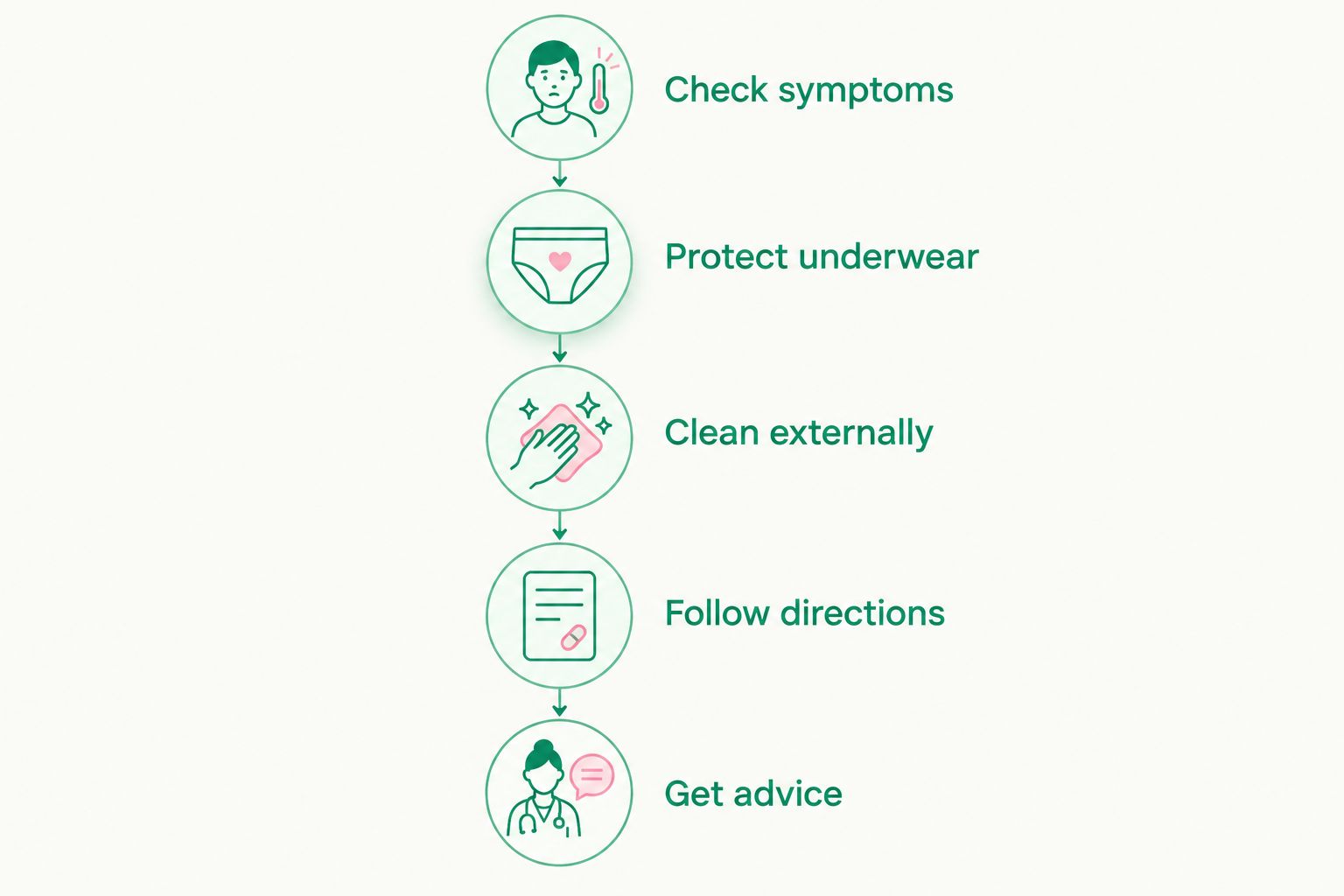
- Check symptoms. Notice whether the leakage comes with burning, pelvic pain, bleeding, fever, or worsening odor. Those details matter more than the size of a wet patch.
- Protect underwear. Use an unscented liner if you need one. Change it when damp, and stop using it if the material irritates your skin.
- Clean externally. Gently rinse the vulva—the external genital skin—with lukewarm water. Do not flush water or cleanser into the vagina.
- Follow directions. Follow the product label and your clinician’s plan. Do not add a dose because you saw leakage or extend treatment because discharge remains.
- Get advice. Contact your clinician if symptoms persist, recur, or worsen. Bring the product name and a clear description of what changed.
The distinction between the vulva and vagina matters here: cleaning fluid from external skin is different from washing inside the vaginal canal. ACOG’s patient education on vulvovaginal health advises against douching.
Should I use a tampon to catch the discharge?
Use an unscented liner rather than inserting a tampon to absorb suppository leakage. Cleveland Clinic’s vaginal boric acid instructions advise against tampons during use because they can absorb the medicine.
If you are menstruating or have another reason to use an internal menstrual product, ask your clinician or pharmacist how to manage your treatment. Do not change the schedule based on guesswork.
Should I wash more often to get rid of the discharge?
Extra washing inside the vagina is not the answer. Douching can disrupt the vaginal environment, and an external cleanser cannot remove or treat the cause of internal vaginal discharge.
If fluid irritates your external skin, rinse gently and pat dry. Stop any cleanser that stings; persistent vulvar soreness needs assessment rather than more cleansing.
When should discharge after boric acid prompt medical care?
New pain, significant irritation, bleeding, or worsening symptoms should not be dismissed as the product working. Stop using boric acid if it causes irritation and contact your clinician.
Seek prompt medical attention for fever or pelvic pain, especially when discharge has changed. Severe pain, heavy bleeding, fainting, or feeling seriously unwell calls for urgent evaluation.
Persistent or recurrent odor also needs a diagnosis. The CDC’s vaginitis guidance states that medical history alone is insufficient to diagnose vaginitis accurately; examination and laboratory testing help identify the cause.
Tell your clinician:
- What symptoms existed before you started the suppository.
- What changed after insertion, including burning or bleeding.
- Which vaginal and external products you have used.
- Whether symptoms improved and then returned.
- Whether pregnancy is possible.
You do not need a perfect description or a self-diagnosis before asking for help. “I started this product, and now I have a new symptom” is useful information.
Is boric acid appropriate for recurring BV or yeast symptoms?
Boric acid is not a universal treatment for vaginal odor or discharge. The CDC describes vaginal boric acid in selected treatment approaches for recurrent BV and certain recurrent yeast infections—not as a substitute for diagnosing every episode.
The distinction matters if you repeatedly treat what feels like the same problem. Similar symptoms can have different causes, and a previously confirmed yeast infection does not prove that the next episode is also yeast.
Discuss recurring symptoms with your clinician before choosing another course. Ask what diagnosis is being treated, why boric acid is appropriate, and what should trigger a follow-up visit.
General evidence about boric acid does not prove that added ingredients improve outcomes. It also does not establish that a particular branded formula prevents recurrence or works faster.
Choosing a product in 2026: keep the treatment goal clear
Kushae’s boric acid suppositories are an option for women whose clinician recommends intravaginal boric acid. The brand’s line is OB/GYN-developed, but that does not make a suppository appropriate for every episode of odor, itching, or discharge.
The boric acid suppositories are named in the catalog as containing probiotics and aloe. That ingredient listing does not establish a clinical benefit for leakage, irritation, or BV recurrence; Kushae formula-specific results require formula-specific evidence.
Before choosing any vaginal product, confirm its intended route, read the full ingredient list, and check the safety instructions. External washes, sprays, and balms are different product categories and must not be inserted into the vagina or treated as BV therapy.
Kushae’s boric acid product information warns against use during pregnancy. If you are pregnant, planning pregnancy, or think pregnancy is possible, do not use it; ask your obstetric clinician about appropriate evaluation and treatment.
FAQ
Is it normal to have watery discharge after a boric acid suppository?
Yes—watery discharge can occur after a boric acid suppository as the product dissolves and fluid leaves the vagina. New pain, burning, bleeding, fever, or worsening symptoms should not be treated as routine leakage.
How long should discharge last after using boric acid?
There is no single duration that confirms discharge is normal for everyone. Follow your product instructions and contact your clinician if discharge persists with odor, itching, pain, or other symptoms rather than extending treatment yourself.
Does discharge mean boric acid is working?
No—discharge does not prove that boric acid is working or that an infection has cleared. Leakage is not a substitute for symptom assessment or follow-up testing when your clinician recommends it.
Should I insert another suppository if some liquid leaks out?
No—do not insert an extra suppository because liquid leaked out. Follow your existing dosing instructions and ask a pharmacist or clinician if an apparently intact capsule came out.
Can boric acid cause burning along with discharge?
Yes—vaginal boric acid can cause local irritation, including burning. Stop using it and contact your clinician if burning develops or worsens; severe pain needs urgent assessment.
Can I use boric acid if I am pregnant?
No—do not use vaginal boric acid during pregnancy. If pregnancy is possible or you are planning pregnancy, ask your obstetric clinician about safe care for discharge, odor, or itching.
What should I do if someone swallows a boric acid suppository?
Contact Poison Control immediately if someone swallows a boric acid suppository; in the United States, call 1-800-222-1222. Do not induce vomiting, and call emergency services if the person collapses, has a seizure, has trouble breathing, or cannot be awakened.
One last thing
The most useful detail is not how much liquid you see. It is what changed after you inserted the product: new burning, a different odor, pain, or symptoms that remain despite treatment.
For your next appointment in 2026, bring a short symptom timeline and the product packaging. That gives your clinician something more useful than a guess based on discharge color—and helps separate expected leakage from irritation or an unresolved condition.


