


This article is for informational purposes only. It is not, nor is it intended to be, a substitute for professional medical advice, diagnosis, or treatment and should never be relied upon for specific medical advice.
Stress can contribute indirectly to odor around your vulva by increasing sweating, but a new vaginal odor is not something to automatically blame on stress. A strong fishy smell, changed discharge, or persistent irritation needs assessment for causes such as bacterial vaginosis (BV), not stronger cleansing. This 2026 guide explains the difference and the next step.
TL;DR
- Can stress cause vaginal odor? Indirectly through sweating, but stress alone does not explain persistent vaginal symptoms.
- Fishy odor or changed discharge deserves medical assessment; smell alone cannot diagnose BV.
- Kushae offers OB/GYN-developed vulvovaginal care; external feminine wash does not treat a vaginal infection.
- Use gentle external care, avoid douching, and seek care for persistent or recurring symptoms.
Can stress cause vaginal odor?
Stress can increase external sweat-related odor; it does not establish the cause of an odor coming from vaginal discharge. The American Academy of Dermatology identifies stress as a sweating trigger. Sweat interacting with bacteria on skin produces body odor, including around the groin.
The distinction is anatomical. Your vulva is external; your vagina is the internal canal. Odor from damp underwear or groin skin and odor associated with changed vaginal discharge call for different responses.
If odor mainly follows exercise or sweating, the guide to exercise chafing and odor covers the external-care side. Use the comparison below to decide what to discuss with a clinician, not to diagnose yourself.
| Pattern you notice | What it can fit | Useful next step | Important limit |
|---|---|---|---|
| Musky odor on sweaty groin skin or underwear | External sweat-related body odor | Gently clean external skin and change damp clothing | Improvement does not rule out a separate vaginal condition |
| Fishy odor, especially with changed discharge | BV or another condition requiring evaluation | Arrange medical assessment | Smell alone cannot confirm BV |
| Odor with itching, burning, or soreness | Irritation or infection | Review exposures and seek assessment if symptoms persist | These symptoms overlap across several conditions |
| Very unpleasant odor with a possible forgotten tampon | Retained vaginal material | Seek prompt help if you cannot remove it easily | Do not keep inserting products to cover the smell |
The CDC’s bacterial vaginosis guidance describes fishy odor and thin discharge among possible BV findings. Its vaginal-discharge guidance emphasizes that history alone is insufficient to accurately diagnose vaginitis.
Why this matters
Blaming stress creates two problems: you can miss a treatable condition, and you can irritate sensitive skin by trying to wash the odor away. Neither means you are unclean. Persistent odor is a reason to investigate, not a reason to scrub harder.
For your 2026 care routine, separate comfort measures from treatment. Gentle external washing addresses sweat and surface residue; treatment for diagnosed BV addresses a vaginal bacterial imbalance. One does not replace the other.
ACOG’s patient guidance on vulvovaginal health distinguishes the self-cleaning vagina from the external vulva. That distinction matters more than whether a product is described as feminine, natural, or pH-balanced.
External sweat odor: start with gentle skin care
Stress-related sweating can make an existing body scent more noticeable. If the odor is mainly on your groin skin after an anxious commute, workout, or long shift, start by removing damp clothing and gently rinsing the external area.
Warm water is a reasonable starting point. If you choose a cleanser, follow its external-use directions and avoid any formula that causes burning, itching, or redness. Do not put wash inside your vagina or use a washcloth to scrub sensitive tissue.
Best for external sweat odor: gentle cleansing and dry clothing. The benefit is straightforward removal of sweat and surface residue. The limitation is equally important: this approach does not diagnose or treat an infection.
Avoid repeatedly washing to check whether you smell completely neutral. A vulva does not need to be scent-free, and repeated exposure to cleansers can aggravate irritation. A routine that leaves your skin comfortable is more useful than one that briefly masks every scent.
Fishy vaginal odor: check for BV rather than assuming stress
A fishy vaginal smell is a recognized BV symptom, particularly when it occurs with thin discharge. Some people with BV have few or no symptoms, so the absence of itching does not exclude it. The CDC describes BV as a change in the balance of vaginal bacteria.
Stress occurring at the same time does not prove that stress caused the bacterial change. A stressful week is context to share with your clinician, not a diagnosis. Tell the clinician whether symptoms follow sex, menstruation, or a new product as well.
Best for persistent fishy odor: clinical assessment. Testing helps distinguish BV from other causes and guides treatment. The limitation of home observation is that odor, discharge, and discomfort overlap across conditions.
The CDC recommends treatment for symptomatic BV. An external cleanser, deodorant, or stress-management exercise is not a substitute for that treatment. If symptoms return after treatment, contact your clinician instead of assuming you need a stronger hygiene routine.
Why odor varies during stressful periods
Several factors can occur together. These explain why the timing of odor alone cannot tell you its cause:
- Sweating: Stress is a recognized sweating trigger, and skin bacteria contribute to body odor.
- Damp clothing: Remaining in sweaty underwear keeps moisture against external skin; changing it is a practical comfort step.
- Menstruation: Blood can temporarily change vaginal pH and scent. An odor that persists beyond your usual pattern needs attention.
- Sex: Semen can temporarily raise vaginal pH. Fishy odor after sex still warrants consideration of BV rather than automatic reassurance.
- New products: Fragranced cleansers, sprays, and other exposures can irritate vulvar skin. Irritation is not proof of infection.
For symptom tracking in 2026, record what changed rather than assigning stress as the explanation. Note the location of the odor, any discharge change, and whether discomfort began after a product. Bring that information to an appointment if symptoms persist.
What should you do when you notice a new odor?
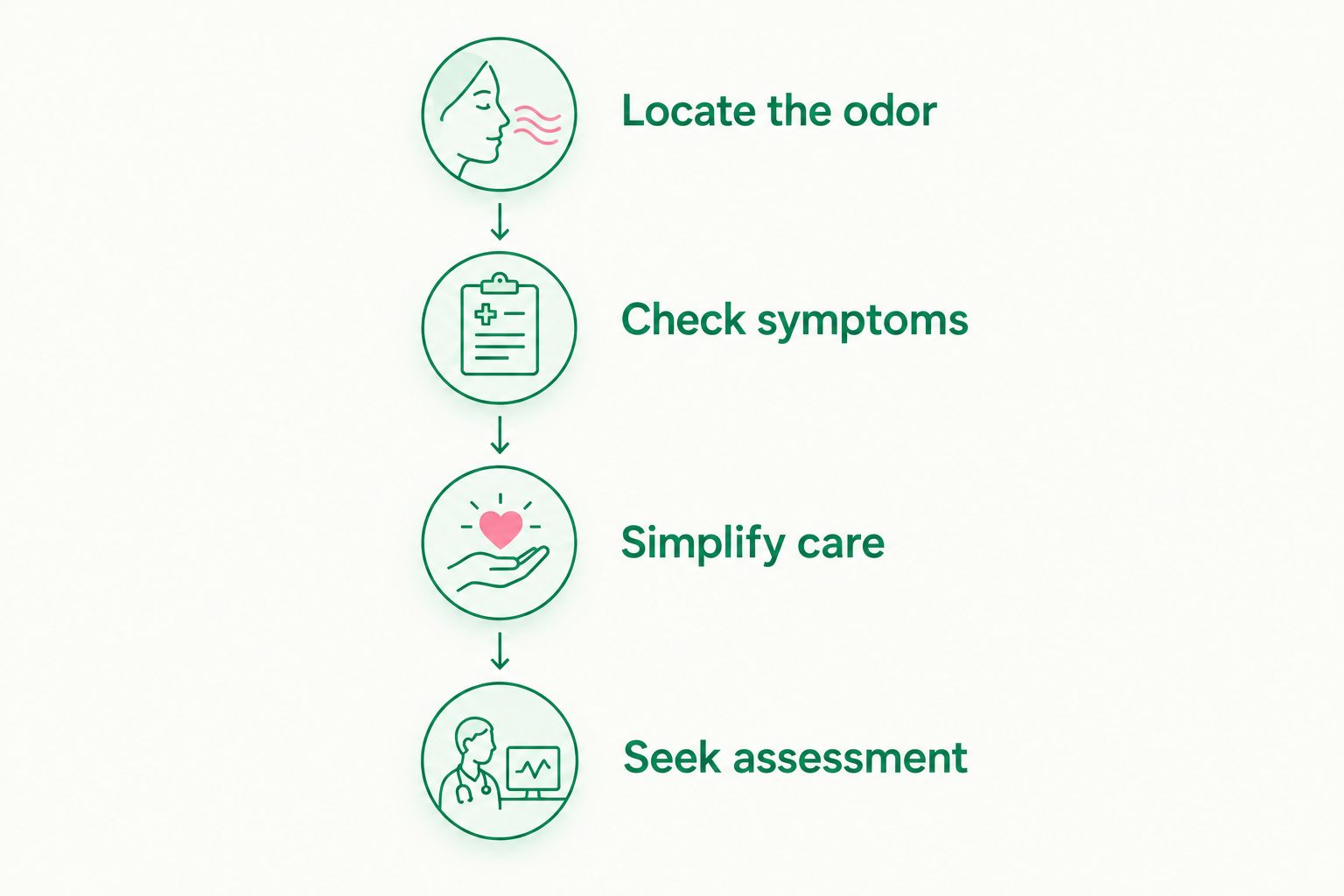
Start with location, then symptoms, then care. You do not need to identify the exact cause before asking for help. This sequence keeps external comfort measures separate from decisions about vaginal treatment.
- Locate the odor. Notice whether it seems tied to sweaty skin, underwear, or changed vaginal discharge. Do not insert objects to investigate.
- Check symptoms. Note itching, burning, painful urination, pelvic pain, bleeding, or a possible retained tampon.
- Simplify care. Gently rinse external skin, change damp clothing, and stop newly introduced products that irritate.
- Seek assessment. Arrange care for persistent, recurring, fishy, or otherwise unusual vaginal odor, especially with additional symptoms.
Make 1 product change at a time if you are simplifying an external-care routine. This is a practical tracking method, not a treatment schedule. It helps you describe which exposure preceded irritation without adding several unfamiliar formulas together.
Keep 2 symptom notes: what changed and when it started. You do not need repeated smell checks throughout the day. A clear account of the pattern is more useful at an appointment than trying multiple odor products first.
Does vaginal pH tell you whether stress is responsible?
Vaginal pH cannot identify stress as the cause of odor. In reproductive-age patients, vaginal pH is commonly about 3.8–4.5 pH units; the CDC includes a vaginal pH above 4.5 pH units among the clinical criteria used to assess BV. A pH result alone does not diagnose BV.
Blood, semen, and life stage can affect interpretation. Menopause is one reason a higher pH does not automatically mean the same thing for every patient. Do not apply an internal vaginal reference range to all external vulvar skin.
For a 2026 home-care decision, treat a pH test as limited information rather than permission to self-treat. It cannot reliably distinguish all causes of odor, and a normal result does not explain persistent symptoms. Tell your clinician about any home result and any product used before testing.
Can a feminine wash help with stress-related odor?
A feminine wash can clean external skin; it cannot establish why vaginal odor developed or treat BV. Water alone is an option, particularly when sensitive skin reacts to cleansers. If you prefer a wash, assess its directions and ingredients rather than relying on its name.
Kushae is an option for women seeking OB/GYN-developed external feminine care, not a substitute for diagnosing vaginal odor. The Kushae Gentle 2-N-1 Foaming Feminine Wash belongs in the external-cleansing discussion, not the BV-treatment discussion. Follow the product’s directions and stop if it irritates your skin.
The benefit of considering Kushae feminine care here is access to an OB/GYN-developed product line. The limit is that product development does not establish that a particular formula treats BV, prevents recurrence, or suits every person with sensitive skin. General medical guidance is not clinical evidence for an individual formula.
| Option | Best for | Benefit | Limitation |
|---|---|---|---|
| Warm water | A simple external rinse | Avoids adding a cleanser | Does not treat vaginal infection |
| External feminine wash | People who prefer a cleanser and tolerate it | Cleans external skin when used as directed | Can irritate sensitive skin; does not treat BV |
| Clinical assessment | Persistent odor or additional symptoms | Identifies causes and informs treatment | Requires an appointment or appropriate clinical service |
Will reducing stress make vaginal odor go away?
Reducing stress can help when stress-triggered sweating contributes to external odor, but it is not a treatment for BV. The answer depends on the source of the smell. Less sweating does not establish that a vaginal infection has cleared.
Use stress support for comfort, not as a condition you must meet before seeking care. Rest, manageable routines, and mental-health support can sit alongside medical assessment. You do not need to prove that you are relaxed before your symptoms deserve attention.
When should you seek medical care for vaginal odor?
Seek assessment when vaginal odor is persistent, recurring, fishy, or accompanied by discharge changes, itching, burning, or painful urination. Tell your clinician if you are pregnant or could be pregnant. Do not start boric acid during pregnancy.
Seek urgent care for odor accompanied by fever, significant pelvic pain, or feeling seriously unwell. A suspected retained tampon also needs prompt attention if you cannot remove it easily. Do not let embarrassment delay care; these are ordinary reasons to contact a healthcare professional.
Before an appointment, ask whether you should avoid vaginal products that could interfere with testing. Share recent treatments, sexual exposures, and symptom timing. A clear history supports assessment, but testing is often needed to identify the cause.
Medical sources behind this guidance
This 2026 guide draws on the following established medical references. These sources support general education, not claims about the effectiveness of a specific branded formula:
- American Academy of Dermatology, sweating guidance: stress as a trigger for sweating.
- CDC, Sexually Transmitted Infections Treatment Guidelines, bacterial vaginosis section: symptoms, diagnostic criteria, and treatment of symptomatic BV.
- CDC, vaginal-discharge guidance: limits of diagnosing vaginitis from history alone.
- ACOG, Vulvovaginal Health patient guidance: anatomy, normal vaginal function, and external hygiene.
- Merck Manual, vaginitis guidance: vaginal pH and interpretation alongside symptoms and examination.
FAQ
Can stress cause vaginal odor without an infection?
Stress can contribute to external groin odor through increased sweating without a vaginal infection. Persistent odor coming with changed discharge still needs assessment rather than being attributed to stress.
Can anxiety make my vulva smell stronger?
Anxiety can trigger sweating, making external body odor more noticeable. Gently rinse external skin and change damp clothing, but seek care if the odor persists or other symptoms develop.
Does a fishy smell always mean BV?
A fishy smell does not always mean BV, although it is a recognized BV symptom. A clinician considers symptoms, examination, and appropriate testing rather than smell alone.
Can I wash away vaginal odor caused by BV?
External washing does not treat BV. It removes sweat and residue from external skin, while symptomatic BV requires appropriate medical treatment.
Should I use boric acid because I smell different when stressed?
A smell change during stress is not a reason to start boric acid without identifying the cause. Boric acid is not appropriate for every condition, must never be swallowed, and should not be used during pregnancy.
Can a pH-balanced feminine wash fix my vaginal pH?
A pH-balanced external feminine wash does not establish or treat the cause of a vaginal pH change. Use external products only as directed and discuss persistent odor or discharge changes with a clinician.
When is vaginal odor urgent?
Vaginal odor needs urgent assessment when it occurs with fever, significant pelvic pain, or feeling seriously unwell. Seek prompt help for a suspected retained tampon that you cannot remove easily.
One last thing
A cleaner-feeling vulva does not prove that a vaginal condition has resolved. Sweat-related odor can improve after rinsing even when an unrelated discharge change remains. Judge your next step by the full symptom pattern, not just how you smell immediately after washing.


