


This article is for informational purposes only. It is not, nor is it intended to be, a substitute for professional medical advice, diagnosis, or treatment and should never be relied upon for specific medical advice.
Yes, you can have BV and a yeast infection at the same time, and both conditions need appropriate treatment when both are causing symptoms. Odor, itching, and discharge overlap, so symptoms alone cannot confirm a mixed infection. The next step is testing—not treating every possible cause at once.
TL;DR
- Can you have BV and a yeast infection at the same time? Yes; CDC guidance supports evaluating both causes.
- BV treatment targets bacteria; yeast treatment targets fungi. Neither automatically treats the other condition.
- Vaginal odor plus itching does not prove a mixed infection. Testing helps distinguish infection from irritation.
- External feminine wash does not treat BV or vaginal yeast infections. Avoid douching and unnecessary products.
Can you have BV and a yeast infection at the same time?
Yes. BV and vulvovaginal candidiasis, commonly called a vaginal yeast infection, can occur together. Clinicians sometimes call this mixed vaginitis when both conditions contribute to symptoms.
Do not assume one condition rules out the other. Likewise, do not assume BV will resolve without care; read more about whether BV can go away without treatment.
The CDC's Sexually Transmitted Infections Treatment Guidelines, in the bacterial vaginosis and vulvovaginal candidiasis sections, describe different diagnostic findings and treatments for these conditions. This comparison summarizes those distinctions for this 2026 guide.
| Finding | BV | Vaginal yeast infection | Both together |
|---|---|---|---|
| Typical discharge | Thin, often white or gray | Often thick and white; appearance varies | No single reliable appearance |
| Odor | A fishy odor is common | Strong odor is not a typical defining feature | BV-associated odor can accompany yeast symptoms |
| Irritation | Can occur | Itching, redness, and soreness are common | Symptoms can overlap |
| Vaginal pH | Often above 4.5 pH units | Usually below 4.5 pH units | pH cannot identify both causes alone |
| Treatment approach | Antibiotic treatment when indicated | Antifungal treatment when indicated | A clinician addresses each confirmed symptomatic condition |
This table is a guide to testing, not a way to diagnose yourself. Some people have atypical symptoms, and other conditions can look similar.
Why this matters
Treating the wrong cause leaves the actual problem untreated. An antifungal does not treat BV, and a standard BV antibiotic does not treat a yeast infection.
Repeatedly adding creams, suppositories, washes, or sprays also makes it harder to tell which product is helping or irritating your skin. Tell your clinician what you used and when, including nonprescription products.
For your 2026 care plan, keep the goal specific: identify the cause of symptoms, treat that cause, and protect sensitive external skin. You do not need to eliminate every natural vaginal scent.
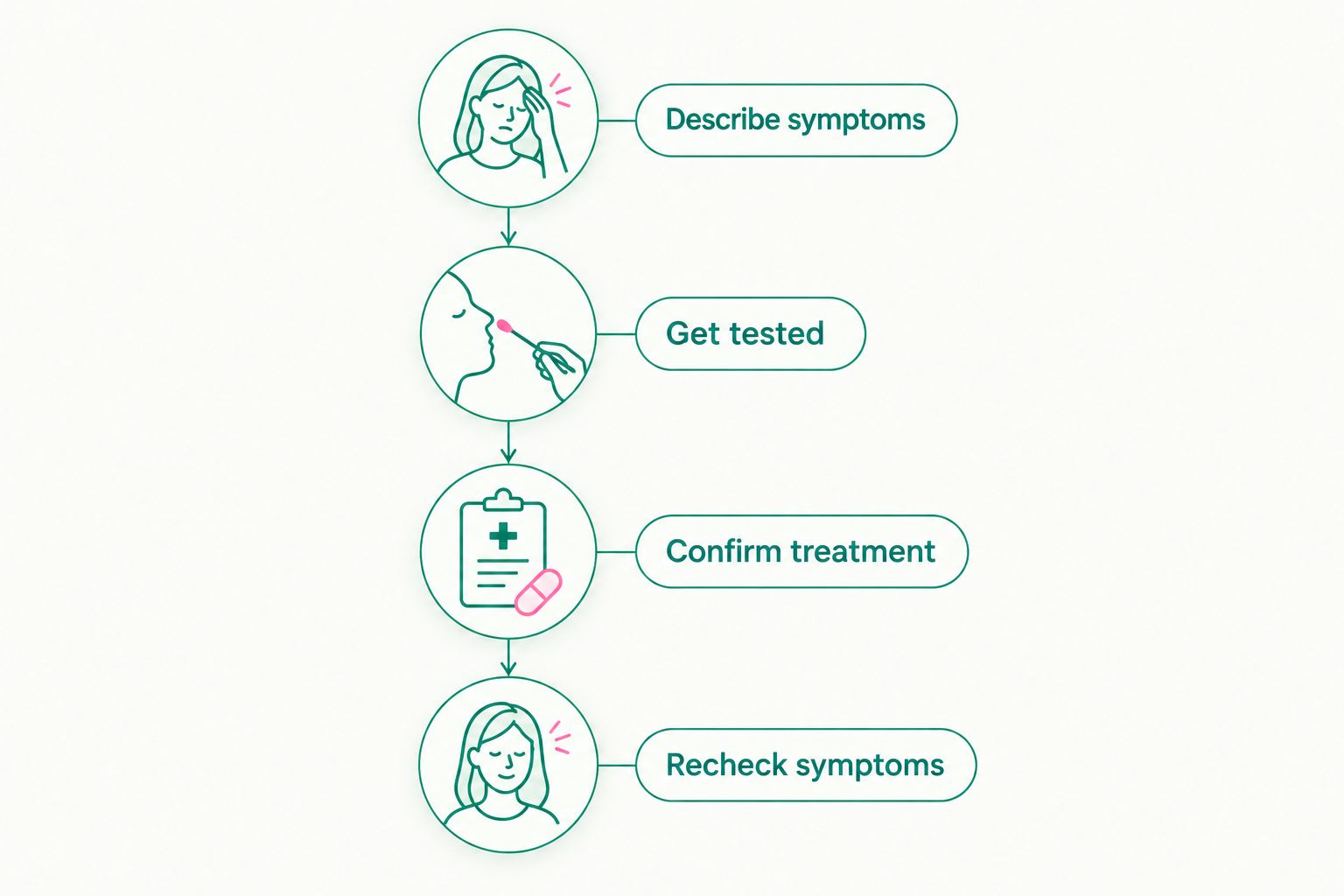
How do clinicians check for both infections?
A symptom history and vaginal sample help distinguish BV, yeast, and other causes of vaginitis. A clinician chooses testing based on your symptoms, examination, pregnancy status, and previous results.
Describe symptoms
Explain whether you have odor, itching, burning, soreness, pain during sex, or a change in discharge. Describe when symptoms started and whether they followed antibiotics, a menstrual period, sex, or a new intimate-care product.
Be clear about location. Burning on the external vulva is not the same as discomfort inside the vagina, although both can happen together.
Get tested
A clinician can examine discharge with microscopy and use pH testing or appropriate laboratory tests. Some molecular vaginal panels check for BV, Candida, and trichomoniasis, but the exact test matters.
A home pH test cannot diagnose yeast or prove that BV and yeast are present together. Blood, semen, and other factors also affect how a pH result should be interpreted.
Confirm treatment
Ask whether a result indicates an infection that explains your symptoms or simply detects an organism. Candida can be present without causing a symptomatic yeast infection, so a positive result alone does not always require treatment.
If both BV and yeast are contributing to symptoms, your clinician can address both. The medicines and schedule depend on the findings, your health history, and possible medication interactions.
Recheck symptoms
Follow the prescribed plan rather than stopping or adding products based on discharge alone. Contact your clinician if symptoms persist, worsen, or return after treatment.
CDC guidance recommends clinical evaluation and testing when symptoms persist after an over-the-counter yeast treatment or recur within 2 months. That recommendation helps prevent repeated treatment of an incorrect diagnosis.
Why symptoms vary when BV and yeast overlap
Not everyone with BV and yeast has the same combination of odor, itching, and discharge. These factors help explain why a symptom checklist cannot replace evaluation:
- Different causes: BV involves a change in vaginal bacteria; candidiasis involves symptomatic yeast overgrowth. Their treatments target different organisms.
- Candida without symptoms: Detecting yeast does not automatically mean yeast is causing your discomfort. Results need clinical interpretation.
- Recent treatment: Antibiotic exposure is a recognized contributor to recurrent yeast infections in some people. New itching after BV treatment deserves assessment, not an automatic diagnosis.
- External irritation: Cleansers, fragrances, and other products can irritate vulvar skin. Contact irritation can resemble infection-related burning or itching.
- Other conditions: Trichomoniasis, cervicitis, and vulvar skin disorders can produce overlapping symptoms. Testing and examination help separate them.
The medical basis is the CDC's vaginitis guidance, including its discussion of infectious and noninfectious causes. These are general clinical findings, not evidence that any individual care product prevents or treats mixed vaginitis.
Can you treat BV and a yeast infection together?
Yes, a clinician can prescribe treatment for both when both are responsible for symptoms. BV generally requires an antibiotic; a symptomatic yeast infection requires an antifungal.
Do not build your own combined regimen from leftover prescriptions and over-the-counter products. Oral and vaginal medicines have different precautions, and some formulations affect barrier contraception. Ask about your exact prescriptions, condoms, and diaphragms.
For a treatment discussion in 2026, bring your medication list and ask:
- Which findings support BV, yeast, or both?
- Should the prescribed treatments start together or follow a particular sequence?
- What should improve, and when should you contact the office?
- Does the treatment affect condoms, diaphragms, or other medicines?
- What is the follow-up plan if symptoms return?
Pregnancy changes treatment decisions. Tell your clinician if you are pregnant, could be pregnant, or are trying to conceive before using vaginal or oral treatments.
Does boric acid treat BV and yeast at the same time?
Boric acid is not a universal first treatment for simultaneous BV and yeast symptoms. CDC guidance includes intravaginal boric acid in specific recurrent-BV strategies and certain difficult-to-treat yeast situations, not as a substitute for diagnosing unexplained odor and itching.
For recurrent BV, boric acid appears within a clinician-directed, multistep approach supported by limited data. For yeast, the organism involved and previous treatment response matter. Those recommendations do not establish that every boric acid formula treats both conditions.
Boric acid is for vaginal use only and must never be swallowed. Keep it away from children and pets, and do not use it during pregnancy. If you are planning pregnancy or pregnancy is possible, speak with your clinician before use.
Boric acid can also cause local irritation. Do not interpret increased burning as proof that a product is working; stop the product and seek advice about new or worsening symptoms.
What can you use on sensitive external skin?
The vulva is external; the vagina is internal. External cleansing can remove sweat and surface residue, but it cannot treat an infection inside the vagina.
Kushae offers an OB/GYN-developed vulvovaginal care line. Kushae is best for women seeking OB/GYN-developed intimate-care products, not a substitute for diagnosis or prescription infection treatment. Development credentials do not prove that a specific formula treats BV or candidiasis.
If you are considering Kushae Gentle 2-N-1 Foaming Feminine Wash, keep the decision separate from infection treatment. Its role here is external cleansing—not treating BV, eliminating vaginal yeast, or establishing why you have odor.
The practical benefit of an external cleanser is surface cleaning. The limitation is that even a product described as gentle can irritate sensitive skin; do not assume a label guarantees personal tolerance.
For irritated skin, keep your routine simple:
- Wash the external area gently with lukewarm water; do not scrub.
- If you use a cleanser, follow its external-use directions and rinse thoroughly.
- Stop products that cause stinging, redness, or worsening itching.
- Avoid douching, internal washing, and deodorizing an unexplained odor.
- Do not add multiple intimate-care products while trying to identify a reaction.
ACOG's patient guidance on vulvovaginal health supports avoiding douching and products that irritate the vulva. That general guidance does not constitute an endorsement of a particular brand or formula.
What if BV or yeast keeps coming back?
Repeated episodes deserve a diagnosis-based plan, not repeated guessing. CDC guidance generally defines recurrent vulvovaginal candidiasis as 3 or more symptomatic episodes in less than 1 year.
That threshold does not mean you should wait for another episode before seeking help. Persistent symptoms, uncertain diagnoses, and treatment failures already justify evaluation.
For your 2026 symptom record, write down confirmed test results, treatments, symptom-free intervals, and possible product reactions. A list of confirmed episodes is more useful than a list of times you assumed you had yeast.
Recurrent symptoms can require yeast culture or other testing to identify a less common Candida species or another explanation. Your clinician can also assess contributing factors, including frequent antibiotic use or diabetes when relevant.
When should you seek prompt medical care?
Seek prompt evaluation for vaginal symptoms accompanied by fever, pelvic or lower-abdominal pain, sores, significant swelling, or unexpected bleeding. Severe pain or feeling acutely unwell needs urgent assessment rather than another home treatment.
Contact your maternity care team if you are pregnant and develop unusual odor, discharge, itching, or burning. Pregnancy is not the time to experiment with boric acid or an unconfirmed treatment plan.
Arrange an appointment for a first episode, symptoms after a new sexual exposure, repeated treatment failure, or symptoms that do not fit your usual pattern. These situations need a broader assessment than a BV-versus-yeast comparison.
FAQ
Can you have BV and a yeast infection at the same time?
Yes, BV and a yeast infection can occur together. Testing helps determine whether both conditions are causing symptoms and need treatment.
Does fishy odor with itching mean I have both infections?
No, fishy odor with itching does not prove that you have both BV and yeast. BV, yeast, other infections, and external irritation can produce overlapping symptoms.
Can a vaginal pH test tell me whether I have BV or yeast?
No, a vaginal pH test cannot diagnose BV or yeast by itself. BV often raises vaginal pH above 4.5 pH units, while yeast usually occurs below that level; examination and additional testing provide the necessary context.
Can BV antibiotics cause a yeast infection?
Antibiotic use can contribute to yeast infections in some people. New itching or discharge after BV treatment still needs assessment because irritation or persistent BV can resemble yeast symptoms.
Should I take an antifungal whenever I take BV medicine?
No, do not automatically add an antifungal to BV medicine. Ask your clinician whether your symptoms, results, or documented history support treatment for yeast.
Can Kushae feminine wash treat BV and yeast together?
No, an external feminine wash does not treat BV or a vaginal yeast infection. External vulvar cleansing and treatment inside the vagina serve different purposes.
How soon should I get checked if yeast symptoms return?
Get evaluated if symptoms persist after an over-the-counter yeast treatment or return within 2 months, as CDC guidance recommends. Repeated self-treatment can delay finding the actual cause.
One last thing
A positive yeast result does not always mean you need yeast treatment. The result must fit your symptoms.
The most useful question to bring to a 2026 appointment is: which findings explain my symptoms, and which treatment addresses each one? That keeps the focus on relief without adding unnecessary products.


