


This article is for informational purposes only. It is not, nor is it intended to be, a substitute for professional medical advice, diagnosis, or treatment and should never be relied upon for specific medical advice.
Yes, boric acid suppositories can cause a burning sensation, including vaginal irritation or discomfort on the external vulvar skin. Burning does not prove the suppository is working, and infection or another skin condition can cause similar symptoms. If burning starts after insertion, stop using the product and contact a healthcare professional before another dose; severe pain, substantial swelling, or trouble breathing requires urgent care.
TL;DR
- Can boric acid suppositories cause a burning sensation? Yes. Stop use and ask a clinician before another dose.
- Vaginal burning and vulvar irritation need different care; neither confirms BV or a yeast infection.
- Kushae boric acid suppositories belong in a clinician-directed plan, not an attempt to push through unexplained burning.
- Do not swallow boric acid or use vaginal boric acid during pregnancy.
Why this matters
Recurring odor or BV concerns can make you eager to try something new. But adding another suppository when you already feel burning can make it harder to distinguish product irritation from the original problem. Your next step is to identify the cause, not increase the treatment.
This 2026 guide separates recognized side effects from symptoms that need medical evaluation. Watery leakage is different from pain; the separate guide to discharge after a boric acid suppository explains that distinction further.
Can boric acid suppositories cause a burning sensation?
Yes. Cleveland Clinic's medication information, Boric Acid Vaginal Suppositories, lists irritation at the application site as a possible side effect. That supports a general safety warning about vaginal boric acid, not a claim about how frequently any particular formula causes burning.
The same medication guidance distinguishes local irritation from allergic reactions that require prompt attention. Use the symptoms below to choose your next action, not to diagnose yourself.
| What you notice | What it does—and does not—tell you | Next action |
|---|---|---|
| Burning after insertion | Local irritation is possible; timing alone cannot establish the cause | Stop use and contact your clinician before another dose |
| Watery leakage without pain | Discharge can occur with vaginal suppositories; it does not establish treatment success | Follow the label and seek advice if discharge is unusual or symptoms persist |
| Burning with odor, itching, or unusual discharge | Infection and noninfectious irritation can overlap | Arrange an evaluation rather than choosing treatment by symptoms alone |
| Severe pain, marked swelling, or bleeding | These are not symptoms to push through | Seek prompt medical assessment |
| Trouble breathing or swelling of the lips, tongue, or throat | These can signal a serious allergic reaction | Call emergency services immediately |
There is no universal amount of burning you should accept. A stronger sting is not evidence of a stronger benefit. Do not use discomfort as a dosing guide or assume that symptoms must worsen before they improve.
What should I do if a boric acid suppository burns?
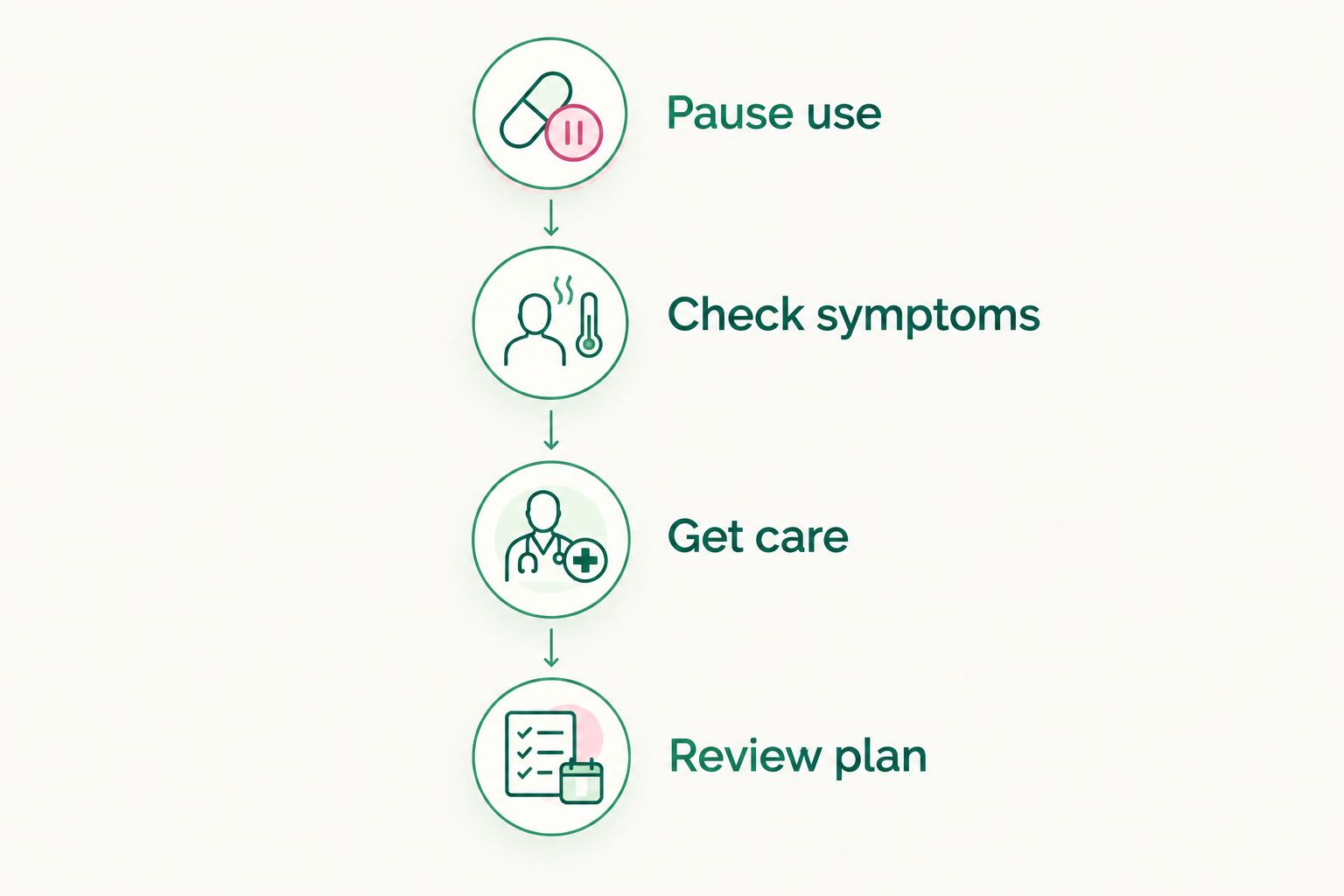
If burning begins after insertion, pause treatment and assess your symptoms before using anything else. Cleveland Clinic's medication guidance advises reporting side effects and avoiding other vaginal products without medical advice.
Pause use
Do not insert another suppository while you are seeking advice about new burning. Keep the package so you can share the complete ingredient list, directions, and the amount you used with a clinician or pharmacist.
Do not double a later dose to compensate for stopping. A clinician can tell you whether to discontinue the product, change the treatment, or investigate another cause.
Check symptoms
Note whether the discomfort is inside the vagina, on the vulva, or both. The vagina is the internal canal; the vulva is the external genital area. That distinction helps your clinician understand what happened.
Write down when the burning began, whether it is worsening, and whether you have discharge, odor, urinary symptoms, bleeding, or swelling. Include any other products used around the same time, such as lubricant, soap, wipes, or vaginal medication.
Get care
Contact your clinician about burning after a suppository, especially if it persists or returns with each use. Seek urgent assessment for severe pain, significant swelling, fever, pelvic pain, or unexpected bleeding. Breathing difficulty or throat swelling is an emergency.
Do not douche or try to flush the vagina to remove the product. If residue is irritating the external skin, gently rinse the vulva with lukewarm water without scrubbing or inserting water inside.
Review plan
Before restarting, ask whether boric acid is appropriate for your diagnosis and whether the specific formula or another exposure could explain the irritation. Bring up pregnancy, possible pregnancy, and any other vaginal treatments.
Why burning with boric acid varies
Burning does not have a single explanation. Medical references describe both medication-related irritation and several conditions that cause vulvovaginal discomfort. These factors help guide the conversation with your clinician:
- Application-site irritation. Vaginal boric acid itself can cause local irritation, as Cleveland Clinic's medication information explains.
- An existing infection. The CDC's vulvovaginal candidiasis guidance lists itching, soreness, and external burning with urination among possible symptoms. Those symptoms are not specific to yeast.
- Contact irritation. ACOG's vulvovaginal health guidance identifies scented products and other irritants as potential contributors to vulvar discomfort.
- Dryness or inflamed tissue. ACOG describes hormonal changes and skin conditions among causes of vulvovaginal symptoms. A product reaction is not the only possibility.
- Other vaginal products. Combining treatments complicates the assessment of irritation. Ask a clinician before adding another vaginal medicine or an external product to an already uncomfortable area.
A reaction after insertion does not automatically mean an allergy. It also does not rule one out. Tell your clinician about rash, hives, or swelling rather than trying to classify the reaction yourself.
Does burning mean boric acid is treating BV?
No. Burning is not a measure of BV treatment success. A change in sensation cannot tell you whether the vaginal bacterial imbalance has resolved or whether BV was the cause in the first place.
The CDC's Bacterial Vaginosis treatment guidance describes boric acid as part of a possible multistep regimen for selected patients with multiple recurrences. It is not the CDC's standard first-line treatment for a new episode of BV, and that limited clinical role does not validate every retail formula.
Vaginal pH above 4.5 is one clinical criterion used when assessing BV. It is not a diagnosis by itself. A home pH result cannot establish why a suppository burns or determine which treatment you need.
If odor keeps returning, ask about confirming the diagnosis and building a recurrence plan. Repeatedly switching products without evaluation can leave the actual cause unaddressed.
How long should burning last after a suppository?
There is no universal safe waiting period for burning after vaginal boric acid. Severity, associated symptoms, and whether discomfort continues all matter more than an arbitrary countdown.
Do not wait for a promised minute or hour threshold before asking for help. Stop use and contact your clinician, especially if the burning persists, worsens, or happens again with each insertion.
Also avoid treating a temporary improvement as proof that the product is appropriate. Tell your clinician whether the discomfort faded after stopping and whether your original odor, itching, or discharge remains.
Can I use a wash or cream to stop the burning?
Do not put feminine wash, deodorant, or skin balm inside the vagina to counteract a suppository. External cleansing and intravaginal treatment have different purposes. Neither an external cleanser nor a deodorant treats BV.
For irritated external skin, keep care simple while you seek advice. Avoid scrubbing, fragranced products, and introducing several new products at once. A cream sold for itching is not automatically appropriate for every cause of burning.
Ask before combining vaginal medications. Treating presumed yeast, BV, and skin irritation simultaneously makes it harder to know what is helping and what is causing discomfort.
Where does Kushae fit into a care plan?
Kushae boric acid suppositories are best considered by women whose clinician recommends vaginal boric acid—not as a response to unexplained burning. The brand offers OB/GYN-developed vulvovaginal care, but development credentials do not replace an individual diagnosis or guarantee that a product will not irritate you.
The Kushae Vaginal Boric Acid Suppositories + Probiotics & Aloe! product is an intravaginal option. Its named ingredients do not establish that it prevents burning, treats every cause of odor, or performs better than another formulation.
For a 2026 purchasing decision, read the complete current label with your clinician or pharmacist. Check the intended route, full ingredient list, directions, and pregnancy warnings. Do not assume that added aloe or probiotics makes a formula irritation-proof.
The relevant benefit is access to a clearly identified vaginal product when boric acid fits your treatment plan. The limitation is equally important: general clinical evidence for boric acid is not evidence that this specific formula will resolve your symptoms.
What safety rules should I know before using boric acid?
Boric acid vaginal suppositories must never be swallowed. Keep them away from children, pets, and anyone who might mistake them for oral medication. Store them in their original packaging rather than alongside pills taken by mouth.
If someone swallows boric acid, contact U.S. Poison Control immediately at 1-800-222-1222. Do not wait for symptoms or induce vomiting unless a poison specialist directs you to do so. Call 911 for collapse, seizures, or breathing difficulty.
Do not use vaginal boric acid during pregnancy. If you are pregnant, could be pregnant, or are trying to conceive, discuss treatment with your obstetric clinician before using it. Burning during pregnancy needs assessment rather than another over-the-counter experiment.
These precautions apply regardless of brand. An intravaginal route does not make a product harmless, and a product described as natural still requires appropriate use.
Medical sources for this 2026 guide
The medical distinctions in this article draw on the following established references. They support general education, not a diagnosis or a clinical claim for a particular retail formula:
- Cleveland Clinic, Boric Acid Vaginal Suppositories: medication use, application-site irritation, precautions, and allergic-reaction warnings.
- CDC, STI Treatment Guidelines: Bacterial Vaginosis: diagnostic criteria and the limited role of boric acid in selected recurrent-BV regimens.
- CDC, STI Treatment Guidelines: Vulvovaginal Candidiasis: overlapping symptoms, diagnostic evaluation, and treatment considerations.
- ACOG, Vulvovaginal Health: anatomy, gentle external care, and causes of irritation.
- U.S. Poison Control: immediate guidance for accidental ingestion.
FAQ
Can boric acid suppositories cause a burning sensation after the first use?
Yes, boric acid suppositories can cause local irritation, including burning, after use. Stop using the product and contact a clinician before another dose; first-time use does not establish whether the cause is irritation, allergy, or an underlying condition.
Is a little burning normal, or should I stop?
Burning is a recognized possible side effect, but it is not a symptom you need to tolerate. Pause use and ask a clinician before continuing, particularly if discomfort persists, worsens, or returns with each dose.
Does burning mean the suppository is balancing my vaginal pH?
No, burning does not demonstrate that a suppository is balancing vaginal pH or treating BV. Vaginal pH above 4.5 is one BV assessment criterion, not proof of the diagnosis or treatment success.
Can boric acid leakage irritate the skin outside my vagina?
Leakage can expose the external vulvar skin to the product and contribute to irritation. Gently rinse external residue with lukewarm water, avoid scrubbing or douching, and contact your clinician about ongoing discomfort.
Can I use boric acid if I am pregnant?
Do not use vaginal boric acid during pregnancy. If you are pregnant, might be pregnant, or are trying to conceive, ask your obstetric clinician about appropriate treatment for burning, odor, or discharge.
Are Kushae boric acid suppositories guaranteed not to burn?
No, an OB/GYN-developed product is not a guarantee against irritation. Discuss the complete formula and your symptoms with a clinician before using or restarting vaginal boric acid.
What should I check before buying boric acid suppositories in 2026?
Check the current label for the intended vaginal route, complete ingredients, directions, and pregnancy warnings. Confirm with a clinician that boric acid fits your diagnosis; packaging claims cannot determine the cause of burning.
One last thing
For your 2026 care plan, record what happened before you forget the details: the exact product, insertion time, other exposures, and where the burning occurred. Bring the packaging to your appointment. That history is more useful than trying to decide whether the sensation means the product is working.
You do not need to push through pain to take vaginal health seriously. Pause, get the cause assessed, and choose treatment that matches the diagnosis.


