


This article is for informational purposes only. It is not, nor is it intended to be, a substitute for professional medical advice, diagnosis, or treatment and should never be relied upon for specific medical advice.
A vulvar skin balm is worth considering in 2026 when your problem is external rubbing or skin discomfort—not vaginal odor, BV, or an unexplained itch. Its value depends on whether the formula suits your skin and its directions cover the area you want to protect; a balm does not diagnose symptoms or replace treatment for an infection.
TL;DR
- Is a vulvar skin balm worth it in 2026? Yes for appropriate external friction care, not unexplained vaginal symptoms.
- Kushae offers an OB/GYN-developed external skin balm for shoppers concerned about chafing; that does not establish BV treatment benefits.
- Choose by application area, ingredients, and skin tolerance—not promises to eliminate vaginal odor.
- Persistent itching, changed discharge, sores, or pain need medical assessment rather than another layer of product.
Why this matters
External irritation and vaginal symptoms require different decisions. The vulva is the external genital area; the vagina is the internal canal. A product intended for external skin does not belong inside the vagina unless its labeling specifically provides for that use.
For someone comparing external friction products, Kushae Protective Feminine Skin Balm is positioned around chafing care. That is a different job from treating bacterial vaginosis, yeast infection, or a vulvar skin disorder.
The American College of Obstetricians and Gynecologists’ patient guidance, Disorders of the Vulva: Common Causes of Vulvar Pain, Burning, and Itching, explains that infections, irritation, and skin conditions can produce overlapping symptoms. Buy for a clearly identified skin-care need, not for a diagnosis you have guessed.
Is a vulvar skin balm worth it in 2026?
Yes, if you need an appropriate protective layer on external skin exposed to friction and you tolerate the ingredients. It is not automatically necessary for healthy, comfortable vulvar skin. Nor is a specialized intimate-care label proof that a product will suit you better than a simpler barrier product.
Compare the job before comparing the packaging:
| Option | Best for | Main benefit | Main limitation |
|---|---|---|---|
| External skin balm | Label-directed external friction care | Adds a protective skin-care step where rubbing occurs | Ingredients can irritate; it does not treat vaginal infections |
| Plain petrolatum | People seeking a simple external barrier, when appropriate | Has a short ingredient list and protects skin | Feels greasy and is not compatible with latex condoms |
| External cleanser | Removing sweat and residue from external skin | Cleans the surface when used and rinsed as directed | Does not provide a lasting barrier or treat BV |
| Clinical assessment | Persistent, recurrent, or unexplained symptoms | Identifies whether treatment is needed | Requires arranging care rather than simply buying a product |
University of Iowa Health Care’s Vulvar skin care guidelines includes external skin protectants among measures used to reduce irritation. That supports the general role of a barrier; it does not prove that every commercial balm has the same ingredients, tolerability, or results.
A useful purchasing test is straightforward: can you name the external problem the balm is meant to address? “My outer skin rubs against clothing” is a clearer reason than “something feels off.” If symptoms are new or unexplained, assessment comes first.
When a balm earns its place
A balm earns a place when its labeled purpose matches your external skin concern and using it does not create new discomfort. Think about the actual contact area: inner thighs, groin folds, and vulvar tissue are not interchangeable application sites.
You also need a practical reason to keep using it. If reducing clothing friction already keeps you comfortable, adding another product is optional. Healthy vulvar skin does not require a growing collection of intimate-care products.
When a balm is the wrong purchase
Skip self-treatment with a balm when the main concern is fishy odor, unusual discharge, sores, or persistent itching. Those symptoms do not identify one condition on their own. Covering the area with a protective product does not establish what is causing them.
The same applies to repeatedly returning symptoms. Temporary comfort is not proof that the underlying issue has resolved. Tell a clinician what you have used and whether symptoms changed after application.
Why a vulvar skin balm’s value varies
The best purchase in 2026 is the one that fits the location and cause of discomfort. These factors matter more than an intimate-care label:
- Application area: A product intended for thighs or groin folds is not automatically suitable for the inner labia or vaginal opening. Follow the exact directions.
- Ingredient tolerance: Fragrance, botanical ingredients, and other components can irritate susceptible skin. “Natural” does not mean nonirritating.
- Type of discomfort: Friction-related surface discomfort calls for a different approach from infection, eczema, or hormone-related tissue changes.
- Product compatibility: Check whether the formulation is compatible with condoms and other products used in the same area. Oil-based products can weaken latex.
- Response to use: New burning, redness, itching, or swelling is a reason to stop using the product, not apply more.
- Existing treatment: If you use prescription vulvar medication, ask your clinician how a barrier fits into that plan rather than layering products yourself.
There is no universal wear-time promise that applies to every balm and every situation. Clothing, activity, washing, and the formula all affect what remains on the skin. Follow the product’s directions instead of borrowing an application schedule from another brand.
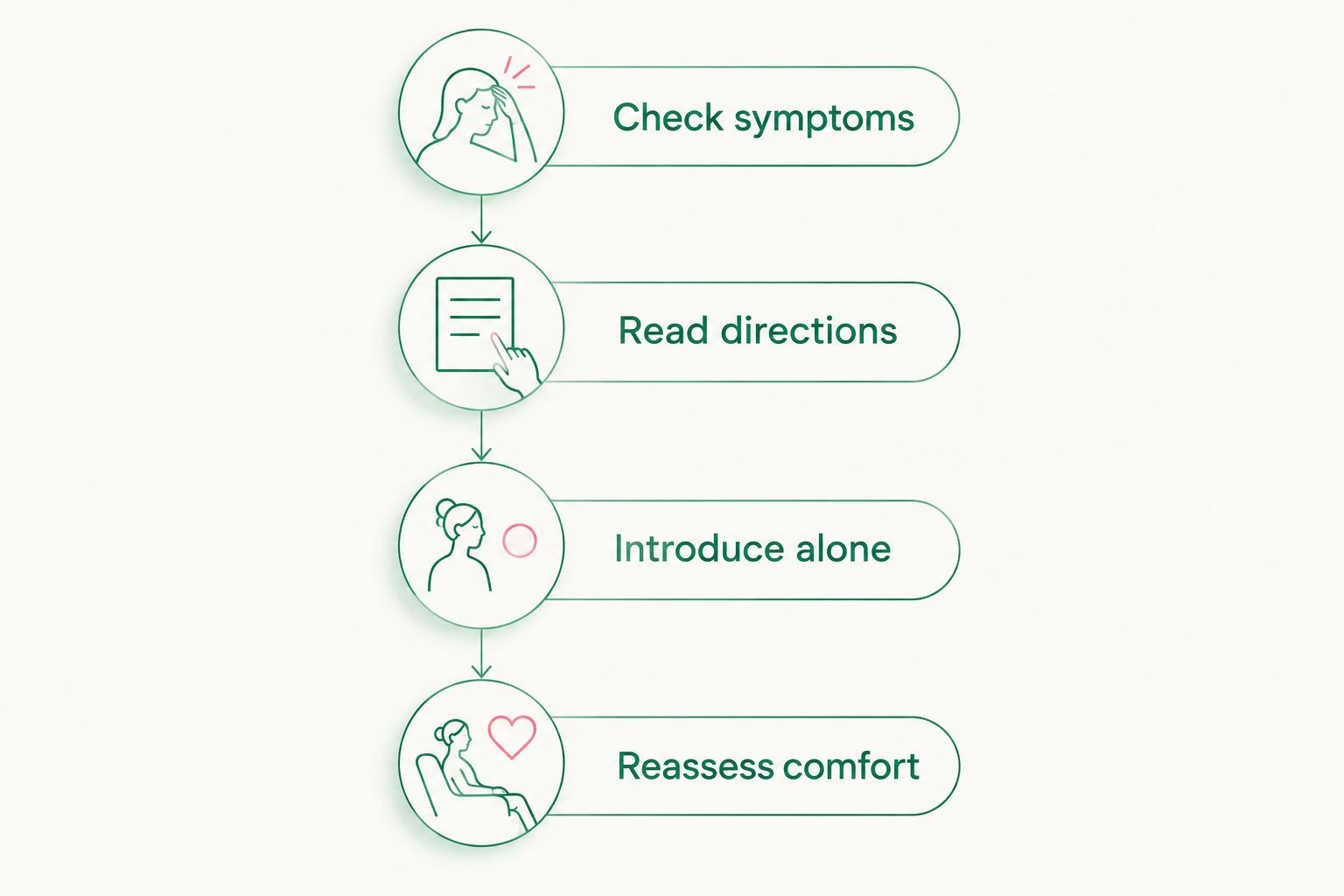
How to evaluate a balm before using it
Use this decision process when comparing vulvar skin care in 2026. It keeps the focus on appropriate use rather than claims that a product will solve every intimate-health concern.
Check symptoms
First, separate external rubbing from symptoms that need assessment. Notice where the discomfort occurs and whether it comes with discharge changes, odor, painful urination, sores, or bleeding. You do not need to diagnose yourself; you need enough information to choose between skin care and medical care.
If the skin is broken, bleeding, or markedly inflamed, ask a clinician before applying a new intimate-care product. A product suitable for intact external skin is not automatically appropriate for damaged tissue.
Read directions
Read the full ingredient list, intended application area, warnings, and use instructions. Do not infer suitability from the words “feminine,” “gentle,” or “OB/GYN-developed.” Those descriptions do not replace directions or your individual allergy history.
Check whether the label addresses your intended location. If it does not, contact the manufacturer or ask a pharmacist or clinician rather than expanding the use yourself.
Introduce alone
Avoid introducing a new balm, wash, spray, and shaving product together. If irritation follows, identifying the trigger becomes harder. Keep the rest of your routine simple while evaluating the new product.
Follow any label instructions for testing tolerance. A small-area test does not guarantee that a product will suit more sensitive vulvar tissue, so do not treat it as permission to use the product everywhere.
Reassess comfort
Judge the product by comfort and skin response, not scent or a cooling sensation. Burning and tingling are not evidence that a balm is working. Stop using it if symptoms begin or worsen.
If you repeatedly need a balm to tolerate everyday clothing or ordinary movement, arrange an assessment. Ongoing discomfort deserves an explanation rather than an increasingly complicated routine.
Clothing and shaving change the purchasing decision
A balm cannot remove the friction created by a tight seam or repeated rubbing. Before adding a product, look at what touches the uncomfortable area: underwear edges, workout clothing, pads, and recently shaved skin all belong in that review.
Choosing underwear for sensitive skin after shaving involves more than the fabric name: fit, seams, and contact with freshly shaved skin also matter. A fabric description alone does not tell you whether a garment will rub at the exact spot that hurts.
If shaving repeatedly triggers discomfort, pause hair removal while the area settles and seek advice for persistent bumps, pain, or inflammation. Do not use a balm to make repeated irritation feel like a normal part of grooming.
The practical sequence is to reduce the source of rubbing, keep care simple, and then consider a suitable external barrier. Buying a balm before checking those triggers can leave the main problem unchanged.
Where Kushae fits—and what its claims do not establish
Kushae vulvar skin balm is best suited to shoppers seeking external friction care, not treatment for BV. The brand describes its line as OB/GYN-developed, and its protective balm is positioned around chafing concerns.
That positioning helps identify the product category. It does not establish that the balm treats eczema, resolves vaginal odor, prevents infections, or works better than another barrier. General evidence about external skin protection is not a clinical trial of this particular formula.
For your 2026 buying decision, read the current ingredient list and application directions before choosing it. If you have known contact allergies or a diagnosed vulvar condition, discuss the formula with your clinician. Medical involvement in product development does not eliminate individual reactions.
The strongest reason to consider a specialized balm is a clear match between its labeled use and your external skin need. The strongest reason to pass is a mismatch—especially when your real concern is persistent vaginal symptoms.
Can a vulvar balm help vaginal odor or BV?
A vulvar balm does not treat BV or explain persistent vaginal odor. External friction care and treatment of a vaginal condition are separate tasks. Do not insert an external balm or use it to cover up a new odor.
ACOG’s Vaginitis patient guidance describes different causes of vaginal symptoms and the need to identify the cause before selecting treatment. A previous episode of BV does not prove that every later change in odor has the same explanation.
Seek prompt care if symptoms include fever, pelvic pain, significant swelling, or painful sores. If you are pregnant and develop new vaginal symptoms, contact your pregnancy-care team rather than starting a self-selected treatment.
Is a vulvar balm better than a feminine wash?
A vulvar balm and a feminine wash do different jobs; neither is a treatment for unexplained vaginal symptoms. A balm is a leave-on external skin-care product when directed that way. A wash cleans the external surface and is rinsed away.
For sensitive skin, more cleansing is not automatically better. ACOG’s vulvar-care guidance emphasizes avoiding irritating products and gentle care. Do not wash inside the vagina, scrub irritated tissue, or assume a pH-related label means a cleanser treats BV.
If your skin is already uncomfortable, simplify rather than adding both products at once. You can evaluate a product more clearly when it has a defined purpose and is the only new variable.
FAQ
Is a vulvar skin balm worth it in 2026 if I only get occasional chafing?
A vulvar skin balm can be worth considering for occasional external chafing when its directions cover the affected area and you tolerate its ingredients. Reducing clothing friction first can also address the trigger without adding a product.
Can I put vulvar skin balm inside my vagina?
Do not put an external vulvar skin balm inside your vagina. Follow the product’s exact application directions; external skin care and intravaginal products are not interchangeable.
Will a vulvar balm treat my recurring BV?
A vulvar balm does not treat recurring BV. Recurrent odor or discharge changes need clinical assessment and a treatment plan based on the cause.
Is plain petrolatum better than a specialized vulvar balm?
Plain petrolatum is one simple external barrier option, but it is not automatically the best choice for every person or application area. Consider ingredient tolerance, clinician advice, and compatibility; petrolatum can weaken latex condoms.
Should a vulvar skin balm burn when I apply it?
Burning is not a sign that a vulvar skin balm is working. Stop using the product if it causes burning or worsening irritation, and seek medical advice if symptoms persist or are severe.
Can I use a vulvar balm if I have eczema?
Ask your clinician before adding a vulvar balm for diagnosed or suspected eczema. A barrier can have a supporting role in skin care, but it does not replace diagnosis or prescribed treatment.
Do I need a feminine wash before applying a balm?
You do not automatically need a feminine wash before using an external balm. Follow the balm’s preparation instructions and avoid scrubbing or adding a cleanser that irritates your skin.
One last thing
A product can feel soothing without treating the cause of discomfort. That distinction matters more than the newest intimate-care label in 2026. Keep a short record of where symptoms occur, what touches the area, and which products make things better or worse; bring it to an appointment if the problem continues.
Your goal is comfortable skin and an understandable routine—not needing more products to get through an ordinary day.


