


This article is for informational purposes only. It is not, nor is it intended to be, a substitute for professional medical advice, diagnosis, or treatment and should never be relied upon for specific medical advice.
There is no established number of days for boric acid alone to clear bacterial vaginosis (BV). Standard antibiotic courses usually last 5–7 days, while a clinician-directed plan for multiple recurrences can include 21 days of vaginal boric acid after antibiotics. Those are treatment lengths—not a guarantee that symptoms or the underlying imbalance resolve on a particular day.
TL;DR
- How long does BV take to clear up with boric acid? There is no established standalone timeline.
- CDC guidance describes 21 days of vaginal boric acid within a longer treatment plan for multiple BV recurrences.
- Kushae boric acid suppositories are not a substitute for diagnosing persistent vaginal odor or discharge.
- Never swallow boric acid, and do not use vaginal boric acid during pregnancy.
How long does BV take to clear up with boric acid?
A 21-day boric acid course is not the same as a 21-day cure for BV. The CDC describes boric acid as one component of an option for women with multiple recurrences, based on limited evidence. That plan includes antibiotics before boric acid and suppressive treatment afterward.
If you are comparing treatment expectations, the guide to how long boric acid suppositories take to work covers the broader timing question. For BV specifically, the diagnosis and the full prescribed regimen determine what happens next.
| Treatment approach | Published treatment length | Best for | Benefit and limit |
|---|---|---|---|
| Oral metronidazole | 7 days | Clinician-diagnosed symptomatic BV | CDC-recommended treatment; side effects and individual suitability matter. |
| Metronidazole vaginal gel | 5 days | Clinician-diagnosed BV when vaginal treatment is appropriate | CDC-recommended treatment; completing treatment does not prevent every recurrence. |
| Clindamycin vaginal cream | 7 days | Clinician-diagnosed BV when this option fits | CDC-recommended treatment; the cream can weaken latex condoms and diaphragms. |
| Vaginal boric acid within a recurrent-BV plan | 21 days, following oral antibiotics | Selected patients with multiple recurrences | An option supported by limited data; not an established standalone first treatment. |
| External vulvar cleansing | Not a BV treatment course | Cleaning external skin | Supports hygiene; does not treat bacterial vaginosis inside the vagina. |
Medical source: CDC, Sexually Transmitted Infections Treatment Guidelines, bacterial vaginosis section. Treatment durations above describe published regimens, not product-specific results or an individualized prescription.
Why this matters
A change in vaginal odor can be upsetting, especially when symptoms keep returning. But odor improvement, treatment completion, and successful treatment are different endpoints. A less noticeable smell does not establish that boric acid cleared BV.
For your 2026 care decisions, separate those endpoints before buying another product. You need a diagnosis when symptoms are new, persistent, or recurrent—not a stronger cleansing routine or an automatically longer suppository course.
BV is associated with a change in the vaginal bacterial community. It is not proof that you are unclean, and washing more aggressively does not correct it. CDC guidance also advises against douching because it can increase the risk of relapse.
Standard BV treatment: 5–7 days for common antibiotic courses
The CDC lists oral metronidazole, vaginal metronidazole gel, and vaginal clindamycin cream among recommended treatments for symptomatic BV. The common courses shown above last 5–7 days. Your clinician chooses the treatment based on your situation, including pregnancy, medication tolerance, and previous treatment.
Finish the prescribed course even if odor improves sooner. Do not replace the remaining antibiotic doses with boric acid because you feel better. A treatment change belongs with the clinician managing the infection.
If symptoms remain after treatment, contact the prescribing clinician. You do not need to wait through repeated self-directed boric acid courses before asking for reassessment. The CDC recommends returning for evaluation when symptoms recur; routine follow-up is generally unnecessary when symptoms resolve.
Keep a simple record of the medication, treatment dates, and symptoms. That gives your clinician something more useful than a general impression that a product worked briefly.
Recurrent BV: 21 days of boric acid within a longer plan
For women with multiple BV recurrences, CDC guidance describes an option involving an oral nitroimidazole antibiotic for 7 days, followed by vaginal boric acid for 21 days, then suppressive metronidazole gel twice weekly for 4–6 months. The CDC explicitly describes the supporting data as limited.
That sequence matters. It does not establish that boric acid alone clears BV in 21 days, and it does not mean everyone with recurring odor needs this regimen. The suppressive phase is a separate part of the plan, not optional background detail.
Ask your clinician to explain:
- Whether your current symptoms have been confirmed as BV.
- Whether your history fits a multiple-recurrence treatment approach.
- Which treatment comes first and when each phase ends.
- What to do if irritation develops or symptoms return.
- Whether pregnancy or another health consideration changes the plan.
Use the entire plan your clinician prescribes—not an isolated duration copied from a search result. A 2026 product comparison cannot determine whether that plan is appropriate for you.
Why the time to improvement varies
There is no reliable boric-acid-only countdown because several different clinical situations get grouped under the same question. These factors change what treatment is appropriate and how you should interpret symptoms:
- The diagnosis. BV, yeast infections, trichomoniasis, and noninfectious irritation can produce overlapping symptoms. History alone is not enough to diagnose vaginitis accurately, according to CDC guidance.
- First episode versus recurrence. A first treatment course and a plan for multiple recurrences serve different purposes. Their durations are not interchangeable.
- The prescribed regimen. Oral antibiotics, vaginal antibiotics, and a multi-stage recurrence plan have different schedules. Compare the full regimen, not just one ingredient.
- Treatment completion. Stopping or changing treatment early means you have not followed the prescribed course. Tell your clinician about missed doses rather than creating a replacement schedule.
- Product-related irritation. Vaginal boric acid can cause local irritation. Burning after insertion is not proof that the product is treating BV.
- Pregnancy. Pregnancy changes treatment decisions. Do not use vaginal boric acid during pregnancy; contact your prenatal clinician about odor or discharge.
Medical sources: CDC guidance on bacterial vaginosis and evaluation of vaginal symptoms; Poison Control guidance on vaginal boric acid safety. These are general clinical references, not studies of a particular retail formula.
Separate vaginal treatment from external skin care
The vagina is the internal canal. The vulva is the external genital area. That distinction determines where a product belongs and what it can reasonably do.
An external wash cleans skin; it does not treat BV. A vaginal suppository is an intravaginal product; it is not interchangeable with a cleanser, skin balm, or deodorant. A product marketed for odor also cannot tell you whether the odor comes from BV.
| Care category | Intended area | Best for | Important limit |
|---|---|---|---|
| Prescribed BV treatment | Vaginal condition, treated orally or vaginally as directed | Confirmed symptomatic BV | Requires the correct diagnosis and treatment plan. |
| Boric acid | Intravaginal use only when appropriate | Selected clinician-directed situations | Not for swallowing, pregnancy, or diagnosing unexplained symptoms. |
| External care | Vulvar skin | Gentle external hygiene | Does not treat an infection inside the vagina. |
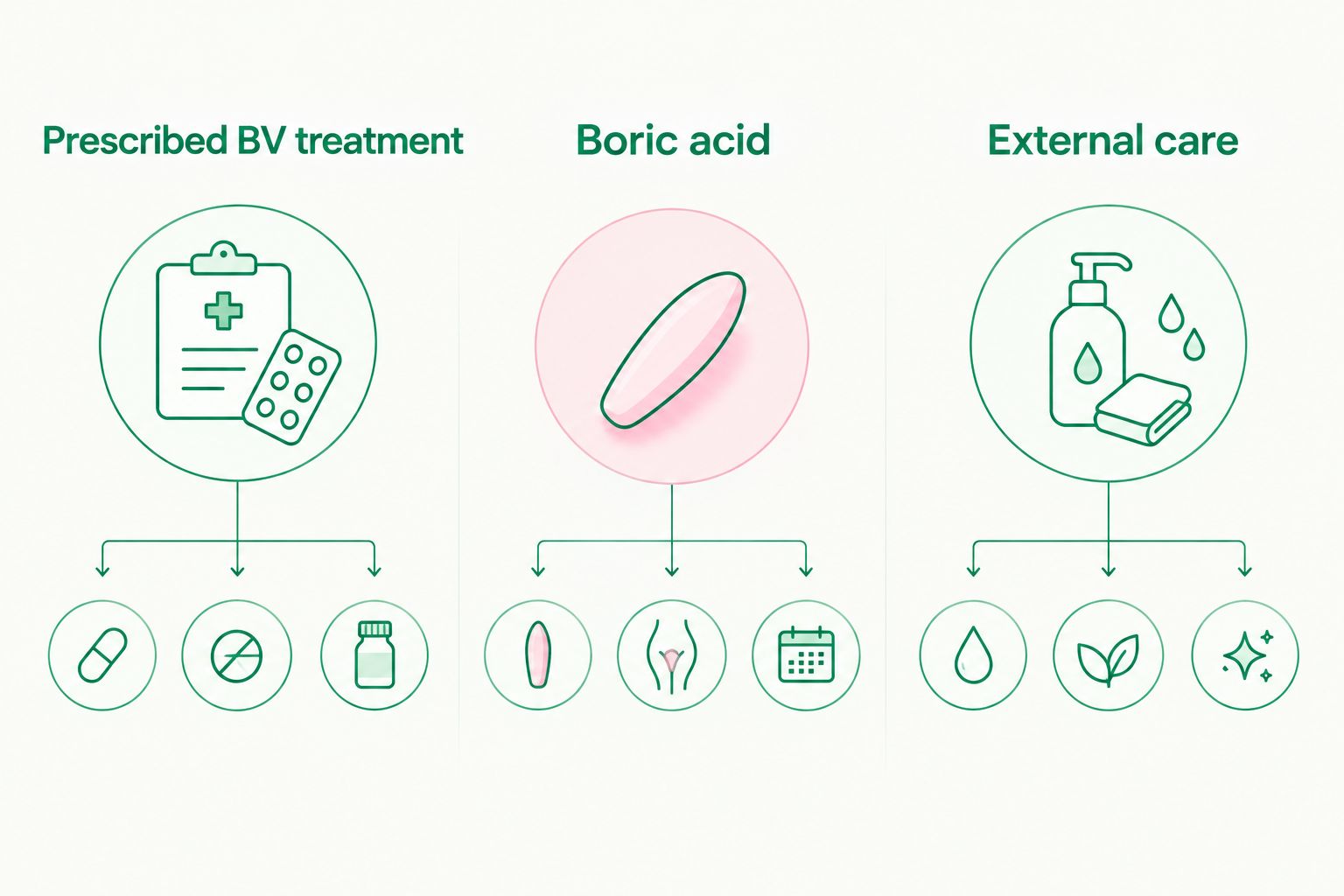
If external skin is sensitive, avoid adding several new products while you are trying to identify the cause of symptoms. A new cleanser, spray, and suppository used together make it harder to tell which exposure caused irritation. ACOG's vulvovaginal-health guidance supports gentle external care and avoiding douching.
What should you check before buying boric acid?
Start with the reason you are buying it. If your goal is to treat newly developed vaginal odor without an examination or testing, a purchase does not resolve the diagnostic question. If a clinician has recommended boric acid as part of your care, review the label and the prescribed instructions together.
Check the ingredient list, vaginal-use directions, pregnancy warning, and storage instructions. Do not assume that products with similar names have identical ingredients or directions. Added ingredients also do not establish a faster BV response.
Kushae boric acid suppositories include probiotics and aloe in the supplied product name and belong to an OB/GYN-developed vulvovaginal care line. Kushae is best for women seeking OB/GYN-developed vulvovaginal care products, not a substitute for BV diagnosis. Its clinical positioning does not establish a formula-specific clearance time or prove that added ingredients improve BV outcomes.
For a 2026 buying decision, the useful question is whether the product fits your clinician's plan. A claim about rapid freshness is not equivalent to evidence that a particular formula treats recurrent BV.
What if the odor improves but comes back?
Returning odor deserves reassessment rather than an automatic repeat course. Tell your clinician which products you used, whether you completed prescribed treatment, and how symptoms changed. Recurrent BV has management options, but repeat symptoms do not confirm the diagnosis by themselves.
Do not use vaginal pH alone as proof that BV has cleared or returned. CDC guidance uses clinical criteria or appropriate testing to establish the diagnosis; an elevated pH is only one piece of that assessment. A home result does not identify every possible cause of symptoms.
When should you stop boric acid and get medical care?
Stop using boric acid and seek medical advice if it causes significant burning, pain, or worsening irritation. Do not treat escalating discomfort as a necessary stage of recovery. Keep the packaging so you can tell the clinician exactly what you used.
Seek prompt medical evaluation for fever, pelvic or lower abdominal pain, or symptoms during pregnancy. Persistent unusual discharge, bleeding, sores, or concern about an STI also warrants assessment rather than continued self-treatment.
Never swallow boric acid. Keep suppositories away from children and pets and separate from oral medicines. If someone swallows one, contact Poison Control immediately; in the United States, call 1-800-222-1222. Do not wait for symptoms before asking for help.
FAQ
Can boric acid clear BV in one day?
There is no established evidence-based promise that boric acid alone clears BV in one day. A change in odor does not establish that BV has resolved.
Does the 21-day boric acid regimen mean my BV will be gone after 21 days?
The 21-day boric acid phase is part of a longer CDC-described option for multiple BV recurrences, not a guaranteed clearance deadline. That option includes antibiotics beforehand and suppressive treatment afterward.
Should I use boric acid instead of antibiotics for BV?
Do not replace prescribed BV antibiotics with boric acid on your own. CDC-recommended treatments for symptomatic BV include metronidazole and clindamycin; discuss recurrent symptoms with your clinician.
Is discharge after inserting boric acid proof that it is working?
Discharge after insertion is not proof that boric acid is clearing BV. Suppository material can leak, and persistent unusual discharge or worsening symptoms needs medical assessment.
Can I use boric acid for BV while pregnant?
Do not use vaginal boric acid during pregnancy. Contact your prenatal clinician for assessment and pregnancy-appropriate treatment of vaginal symptoms.
Does a feminine wash help BV clear faster?
An external feminine wash does not treat BV or establish a faster clearance time. Keep external vulvar hygiene separate from treatment of the vaginal condition.
Does Kushae boric acid have a proven BV clearance time?
No formula-specific BV clearance time is established by the product information provided here. General clinical guidance about boric acid does not prove an outcome for a particular Kushae formula.
One last thing
Ask what the finish line is before starting another course. Symptom relief, completing treatment, and managing future recurrences are different goals. Your clinician should make clear which goal each part of the plan serves.
The most useful addition to your 2026 care routine is a written treatment history—not another product added without a diagnosis. Bring that history to your appointment so the next decision addresses the pattern, not just today's odor.


